 By st20113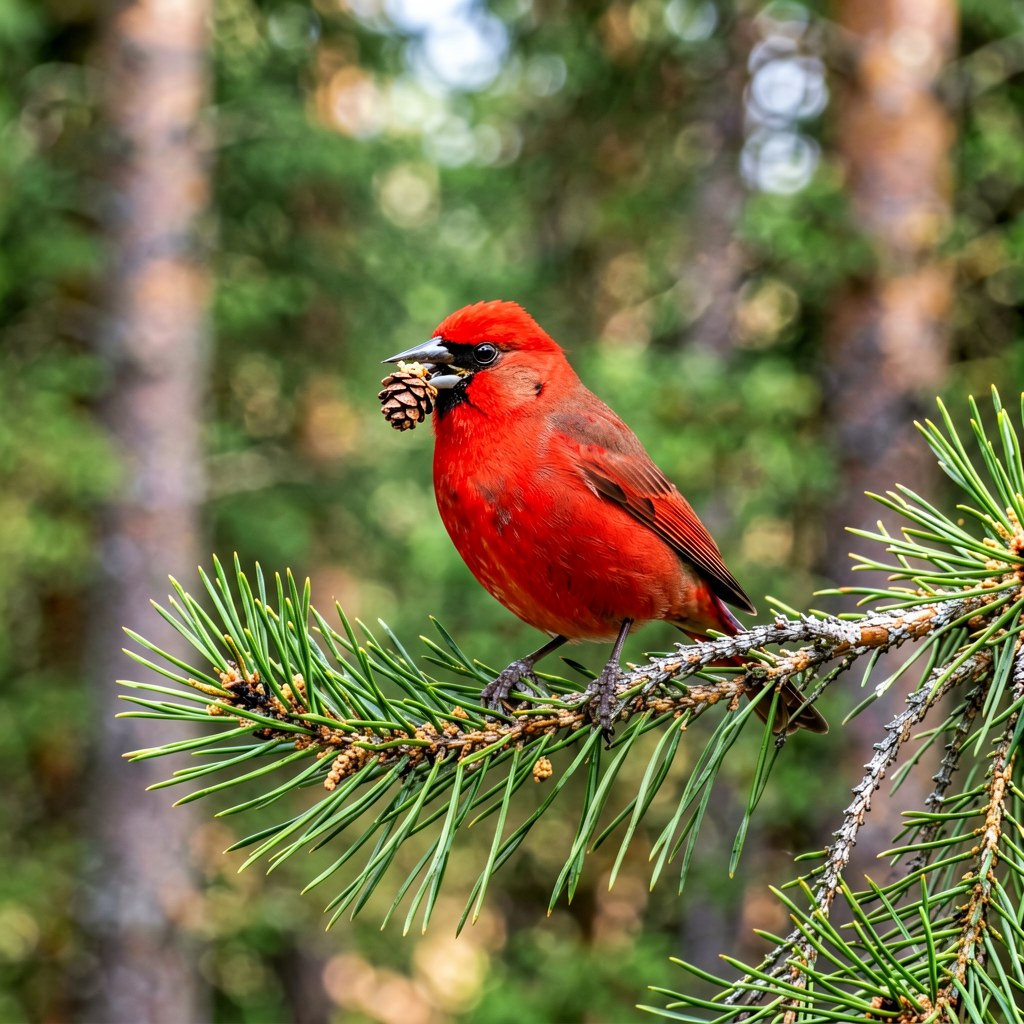
Loxia curvirostra | Red Crossbill
Introduction
The red crossbill, Loxia curvirostra, is one of the most peculiar songbirds in the northern forests, instantly recognisable by the tips of its mandibles that cross over each other like a pair of tiny forceps. This unusual bill is not a deformity but a precision tool, evolved to pry open the tough cones of conifer trees and extract the nutritious seeds within. Males are a vivid brick-red and females a streaky greenish-yellow, and both show the same oddly shaped beak and a notched tail. Red crossbills are birds of the boreal and montane coniferous forests of the Northern Hemisphere, from North America and Europe across Siberia to East Asia. They are famously nomadic, wandering widely in search of good cone crops, and their call—a sharp, metallic chip—often announces their presence before the bird itself is seen flitting among the treetops.
Taxonomy
Loxia curvirostra belongs to the family Fringillidae, the true finches, within the genus Loxia, whose members all share the crossed bill. As a perching bird it is a passerine, the enormous order Passeriformes that includes the familiar [Common Blackbird](https://www.gloencyc.com/common-blackbird-turdus-merula/) and most other songbirds, all united by the arrangement of their toe tendons and their mastery of song and complex vocal learning. Within Fringillidae the crossbills form a distinctive group specialised for conifer feeding, separate from the seed-cracking buntings and goldfinches. The genus name Loxia comes from a Greek word for “crosswise,” a direct reference to the bill, and curvirostra means “curved beak.” The red crossbill is actually a complex of several isolated populations that differ in call, bill size, and cone preference, and some biologists treat these as separate species, though the traditional single species remains widely recognised.
Physical Characteristics
The defining trait of the red crossbill is its bill, in which the upper and lower mandibles curve and cross at the tips. This arrangement lets the bird insert the slightly opened beak between the scales of a conifer cone, then close the mandibles so the crossed tips lever the scales apart and expose the seed, which is then extracted with the tongue. The tongue even bears a small groove to channel the seed. Males are mostly red on the head, breast, and rump, while females and juveniles are olive to yellowish-green with dark streaks; both sexes have dark wings and a short, forked tail. They are compact finches, about fifteen centimetres long, with a strong, slightly notch-tipped bill and feet well suited to clambering along branches. Their plumage provides camouflage among pine needles, and their thick, conical bill reflects the heavy-duty feeding they perform rather than the delicate seed-cracking of many relatives.
Habitat
Red crossbills are birds of coniferous woodland: spruce, pine, larch, hemlock, and Douglas-fir forests across the boreal zone and in mountains farther south. They are also found in planted conifer plantations and ornamental stands where food is available. Crucially, they are not tied to a single place; their habitat is wherever a good cone crop currently exists, and they may appear unexpectedly far from their usual range when a distant forest mast-produces heavily. They breed at a range of elevations, from sea-level taiga to subalpine stands, and roost communally in cold weather. Because their entire life revolves around conifer seeds, the structure of their habitat matters less than the simple presence of mature, seeding trees, and they will abandon an area as soon as the local cones are exhausted and move on to the next bonanza.
Diet
The diet of the red crossbill is overwhelmingly conifer seeds: pine, spruce, larch, hemlock, and fir, chosen according to local abundance and the bird’s particular bill size. Using its crossed mandibles, it pries apart cone scales and lifts out the seed, often discarding the cone itself. The birds are so efficient that a flock can strip a tree of accessible seeds in days. During the breeding season they also take insects, especially to feed protein-hungry nestlings, but at other times animal food is minimal. The crossbill’s entire anatomy—bill, tongue groove, digestive tract, and even the timing of breeding—is tuned to the irregular boom-and-bust cycle of conifer seeding. Remarkably, they can assess seed availability by the sound a cone makes when bitten, allowing them to work quickly through ripe crops and ignore empty ones.
Reproduction
Uniquely among many temperate songbirds, red crossbills may breed at almost any time of year, including the depths of winter, provided there is a sufficient cone crop to feed their young. They build a shallow cup of twigs and lichens, usually placed high on a horizontal conifer branch well out from the trunk. Clutches of three to four eggs are incubated chiefly by the female while the male feeds her, and both parents provision the nestlings with regurgitated seeds. Because the trigger for breeding is food rather than season, different populations nest in different months, and a single pair might raise young in January in one year and July in another. This flexible strategy lets crossbills exploit abundant seed supplies whenever they occur, giving them an edge over more seasonally fixed competitors in the unpredictable conifer forests they inhabit.
Conservation
The red crossbill is globally assessed as Least Concern and remains widespread across the coniferous forests of the Northern Hemisphere. Its nomadic lifestyle and ability to breed whenever food is plentiful make it resilient to local shortages, and it can recolonise areas quickly after cone crops recover. The main long-term concern is the loss and fragmentation of mature conifer forest, particularly the even-aged management of plantations that reduces the diversity and continuity of seeding trees. Climate-driven shifts in conifer productivity could also affect the boom-bust cycles the species depends upon. No special protection is needed at present, but maintaining a mosaic of age classes in managed forests—so that some trees are always maturing and seeding—benefits crossbills alongside a wide community of other conifer-dependent birds and mammals.
Birdwatchers know the red crossbill for its dramatic irruptions, years when huge numbers push far south or to lower elevations in search of failing northern cone crops, suddenly appearing in regions where they are otherwise rare. These movements, tracked by citizen-science programmes, provide a living record of conifer mast cycles across continents. Researchers have used the species’ distinct call types, each tuned to a preferred tree, to map the boundaries of cryptic populations, and its nomadic lifestyle makes it a useful study system for understanding how animals track pulsed, unpredictable food resources in a warming climate that may shift the geography of boreal seeding.
Fun Facts
- The crossbill’s bill crosses left-over-right or right-over-left, and the two forms are roughly equally common within a population.
- Unlike most songbirds, it can breed in the middle of winter if a heavy cone crop provides enough food for its chicks.
- Different red crossbill populations specialise in different conifer species and even “speak” in slightly different call dialects.
- The bird often twists the cone off the branch and holds it with a foot while prying out the seeds, much like a parrot with a nut.
- Its tongue has a tubular groove that helps it channel each extracted seed neatly to the back of the mouth.