 By st20113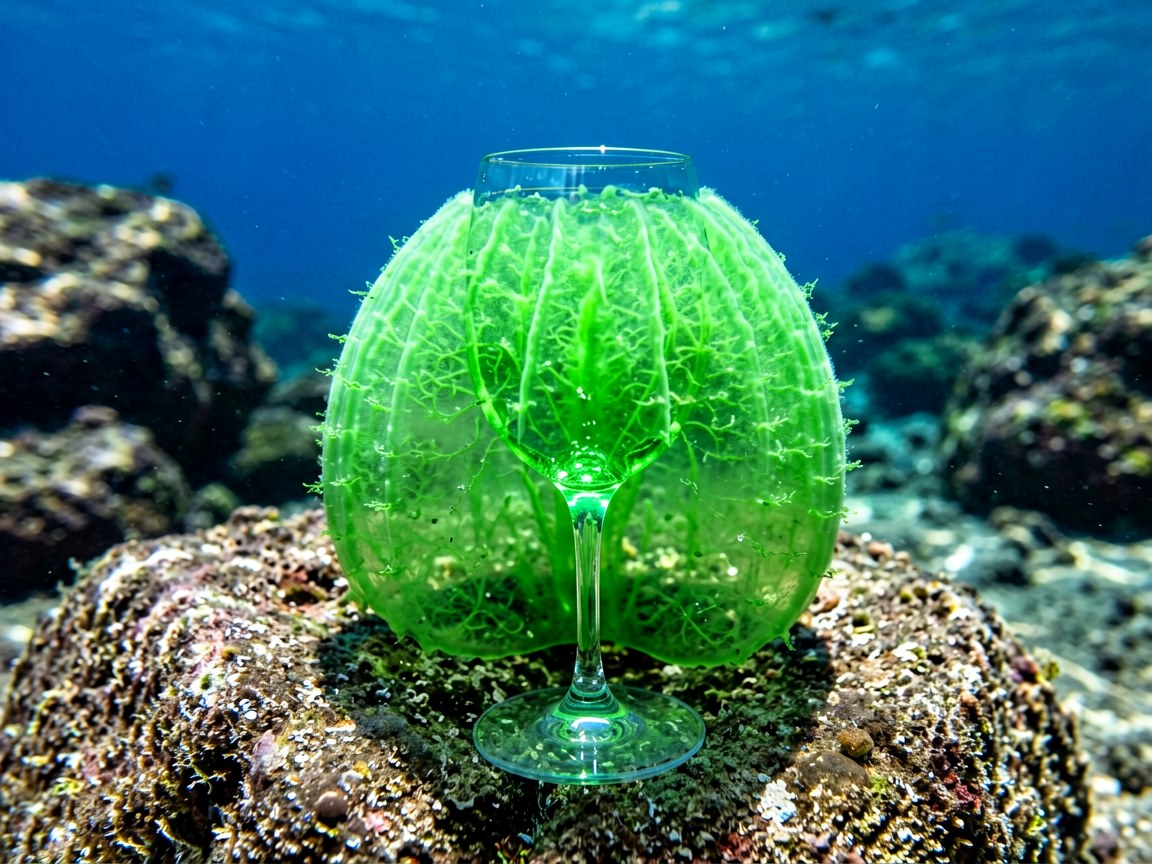
Acetabularia acetabulum | Mermaid’s Wineglass
Introduction
Acetabularia acetabulum, whimsically called the mermaid’s wineglass or the Galilean cap, is a green alga that looks less like a microbe and more like a tiny umbrella or wine glass standing in shallow seawater. Unusually for a single cell, it can grow several centimetres tall — gigantic by cellular standards — with a slender stalk crowned by a circular canopy of radiating branches. Found attached to rocks and shells in the Mediterranean and neighbouring Atlantic, it has been a favourite of cell biologists for over a century because, despite being one cell, it shows clear division of labour between “root,” stalk, and cap. Classic experiments in which the cap was cut off and regrew, or the nucleus was transplanted, helped reveal that the nucleus directs the building of form even after the structure is removed. As a photosynthetic alga it quietly underpins the shallow marine food web, capturing sunlight, and it remains a living lesson in how a single cell can mimic the architecture of a whole plant.
Taxonomy
Acetabularia acetabulum belongs to the family Polyphysaceae within the green algae (Chlorophyta), the same great group that includes the pond scums and the ancestors of all land plants. The genus Acetabularia contains several species of “jointed” or “hat” algae found in warm seas, and A. acetabulum is the Mediterranean representative, historically common from shallow rocky shores to seagrass meadows. Like other green algae it depends on the light-capturing process detailed in our profile of [photosynthesis and the plant energy process](https://www.gloencyc.com/photosynthesis-plant-energy-process/), which supplies the energy to build its giant single cell. The name Acetabularia comes from the Latin for “little vinegar cup,” a nod to the cup-like cap, while acetabulum was the Roman term for a small drinking vessel. Although it resembles a multicelled plant with root, stem, and leaf, it is genuinely unicellular: the entire organism is one cell with a single enormous nucleus housed in the basal “rhizoid.” This makes it a charophyte-green-algal relative of the lineage that gave rise to terrestrial plants, and its study has illuminated how cellular organisation and genetic control evolved long before true multicellular bodies appeared.
Physical Characteristics
The most striking feature of Acetabularia is its size and form as a single cell. A mature specimen consists of a colourless, hair-like stalk up to about five centimetres tall, anchored by a forked, holdfast-like rhizoid at the base and topped by a flattened, umbrella- or wineglass-shaped cap. The cap is built from many slender rays arranged like the spokes of a parasol, and in A. acetabulum these rays are typically unbranched and joined at the rim into a continuous canopy. The whole cell is enclosed in a firm but flexible wall of cellulose, and the interior is a single continuous compartment filled with cytoplasm and many chloroplasts that give it a bright green tint. A single large nucleus sits in the rhizoid, directing the synthesis of proteins that travel up the stalk to build the cap. Because there is only one nucleus for the entire tall structure, the alga became the perfect subject for experiments showing that form is controlled centrally: remove the cap, and a new one regrows under the distant nucleus’s instruction.
Habitat
Acetabularia acetabulum lives in the subtidal and lower intertidal zones of the Mediterranean Sea and adjacent Atlantic coasts, attached to hard surfaces such as rocks, pebbles, and empty shells in clear, sunlit water. It favours positions where light is ample but water movement is modest, often in sheltered bays, lagoon edges, and within Posidonia seagrass beds where the holdfast can grip firm substrate. It grows best in the well-lit shallows where its chloroplasts can photosynthesise efficiently, and it is sensitive to heavy siltation or shading that would smother the rhizoid or block light. Being a warm-temperate to Mediterranean species, it does not extend into cold northern waters, and its populations track the distribution of suitable rocky, sunlit bottom. Because it is anchored and slow-growing, it depends on stable substrate and clean water, and it is typically absent from turbid harbours or scoured, mobile sediments.
Diet
Like other green algae, Acetabularia acetabulum is a photosynthetic autotroph. Its many chloroplasts, distributed along the stalk and within the cap, capture sunlight and convert carbon dioxide and water into sugars, supplying the energy to build and maintain its unusual giant-cell architecture. The cap’s broad, flattened shape actually maximises the light-catching surface for an organism rooted in place, and the canopy’s orientation helps intercept diffuse light in the underwater shade of seagrass meadows. It absorbs dissolved minerals — nitrates, phosphates, and trace elements — directly from the surrounding seawater across its cell wall, needing no roots in the soil sense. The sugars produced not only fuel growth but are stored as starch-like reserves that the single cell draws on through the night and during cap regeneration after damage. Through this simple economy of light and seawater, the alga supports the grazing snails and small invertebrates that browse the canopy and, indirectly, the fishes that feed on them.
Reproduction
Acetabularia has a life cycle built around the alternation of two single-celled generations, and its reproduction is intimately tied to the cap. When the alga matures, the umbrella-shaped cap produces and releases numerous tiny cysts containing gametes; these gametes fuse to form zygotes that settle and grow into the next vegetative cell. Before releasing gametes, the cap functions as a reproductive structure, which is why damaging it does not kill the alga — the rhizoid simply rebuilds a new cap under the nucleus’s direction. The giant vegetative cell itself is diploid and long-lived through the growing season, and the nucleus in the base coordinates the entire developmental programme, including the species-specific pattern of the cap’s rays. Classic transplantation experiments showed that a nucleus from one species implanted into the stalk of another directed the regrowth of the donor species’ cap shape, proving that form is encoded centrally. After releasing gametes, the original cell senesces, completing a cycle that trades the individual for the next generation.
Conservation
Acetabularia acetabulum is not listed as a threatened species, and as a widespread Mediterranean alga it is common across suitable habitat. Its main vulnerabilities are the same as those facing many shallow-water algae: coastal construction, dredging, nutrient pollution that fuels turbidity and shading by competing algae, and the degradation of seagrass meadows that provide much of its anchoring substrate. Because it is sensitive to silt and light loss, declines in local water clarity can reduce its abundance even where it was once plentiful. It is also collected, in small numbers, for teaching and research, though this is negligible compared with habitat pressure. Protecting the clear, sunlit, hard-bottom shallows of the Mediterranean — including Posidonia meadows — safeguards not only this alga but the diverse communities that depend on healthy nearshore ecosystems, making Acetabularia a quiet indicator of intact coastal light and water quality.
Fun Facts
- The entire organism is a single cell, yet it can grow several centimetres tall with a stalk, “root,” and cap.
- Its one nucleus sits at the base, yet it directs the regrowth of the cap even after the top is cut off.
- Landmark experiments transplanted nuclei between species and proved the nucleus controls the cap’s shape.
- Its cap acts like a tiny solar panel, spreading wide to catch light on the sea floor.
- Despite looking like a miniature plant, it is a green alga and a relative of the ancestors of land plants.