 By st20113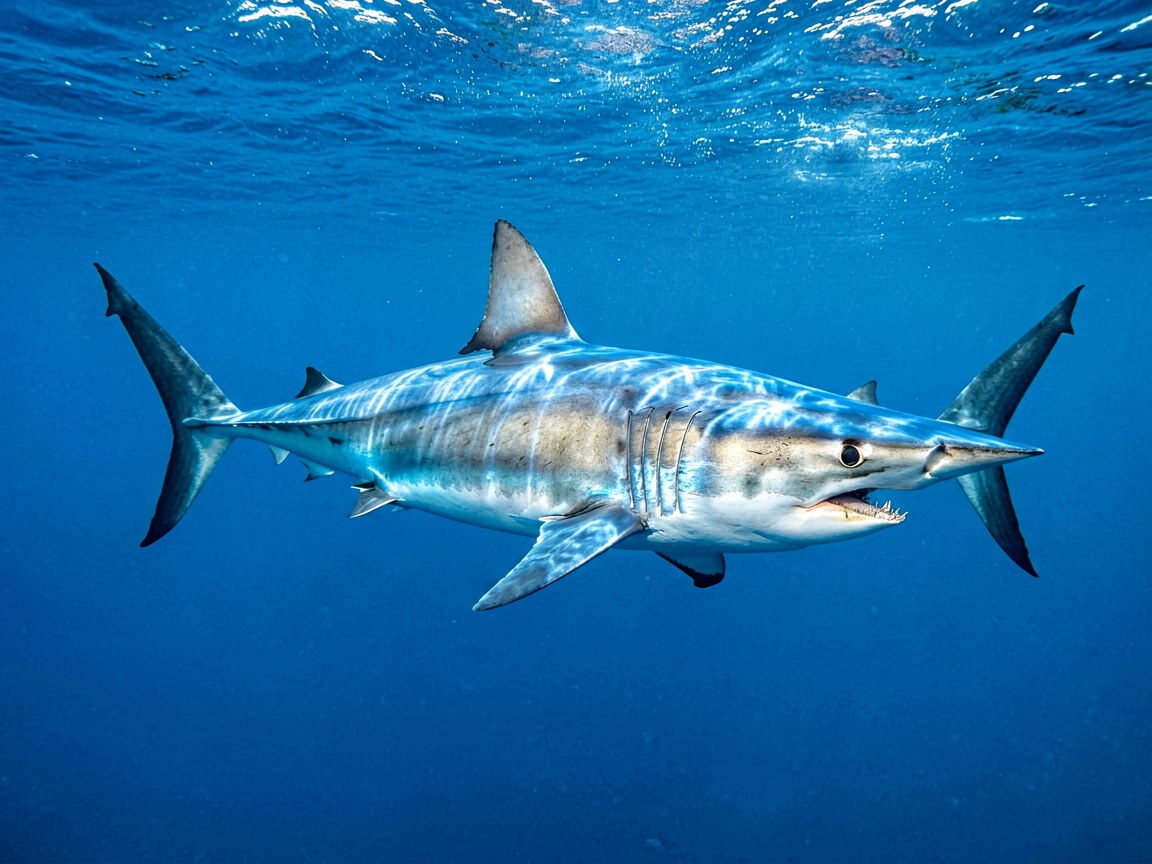
Isurus oxyrinchus | Shortfin Mako
Introduction
Isurus oxyrinchus, the shortfin mako, is the fastest shark in the ocean, a sleek, metallic-blue predator built for speed and power. Found in temperate and tropical seas worldwide, it is renowned among anglers and marine biologists alike for its leaps, endurance, and razor teeth. As the only shark known to consistently exceed speeds that let it chase down swift prey like tuna and swordfish, the mako is a top open-ocean hunter. It is also a commercially valuable species, taken in fisheries for meat and fins, which has driven steep population declines in parts of its range. Its combination of grace, speed, and vulnerability makes it one of the most studied and most conservation-priority sharks in the world.
Taxonomy
Isurus oxyrinchus belongs to the family Lamnidae, the mackerel sharks, the same group that includes the great white, the porbeagle, and the salmon shark. The genus Isurus contains the makos, with oxyrinchus meaning “sharp snout” in reference to the long, conical rostrum. The shortfin mako is closely related to the [Great White Shark](https://www.gloencyc.com/carcharodon-carcharias-great-white-shark/), and the two share the lamnid traits of a torpedo-shaped body, a crescent tail, and regional endothermy that lets them keep key muscles warmer than the surrounding water. Within Lamnidae the mako is separated by its slender build, long pectoral fins, and the lack of the great white’s bulky girth. Its streamlined form is the clearest sign of a life lived at speed in the open sea.
Physical Characteristics
The shortfin mako is built like a torpedo: a fusiform body, a tall crescent-shaped caudal fin, and long, narrow pectoral fins that give lift at speed. Adults commonly reach two to three meters and can exceed four meters and several hundred kilograms in exceptional cases. The coloration is striking, with a brilliant metallic blue back fading to a white belly, a counter-shading that hides it from above and below. The snout is pointed, the eyes large and black, and the mouth is filled with long, slender, hooked teeth ideal for gripping slippery fish. A defining feature is its warm-blooded physiology: a network of blood vessels called the rete mirabile conserves heat from swimming muscles, raising body temperature well above the water and supporting bursts of speed. Some individuals have been recorded at speeds over seventy kilometers per hour, and the mako can leap several meters into the air when hooked.
Habitat
Shortfin makos are pelagic, ranging across the open ocean from the surface down to several hundred meters, though they favor temperatures roughly between fifteen and twenty-five degrees Celsius. They undertake broad movements, sometimes crossing entire ocean basins, following warm currents and the schools of prey fish they hunt. They are found off continental shelves and around seamounts and upwellings where food concentrates, and they are common in the Atlantic, Pacific, and Indian Oceans, absent only from the coldest polar seas. Tagging shows they can dive deep by day and rise at night, tracking the vertical migrations of prey. They are encountering humans mainly where longline and sport fisheries operate, since they rarely approach shore except when chasing bait fish. Their vast range makes them a truly cosmopolitan predator of the blue water.
Satellite tagging has revealed that individual makos may travel thousands of kilometers in a year, crossing entire ocean basins along warm-current highways and returning to productive upwelling zones season after season. Some animals show strong site fidelity to particular seamounts where prey gathers, while others roam widely, making unified management difficult. They routinely dive several hundred meters during the day, following the deep scattering layer of prey upward at night, a vertical commute that mirrors the daily rhythm of the open ocean. This mobility means a mako born off one continent may be caught in the fishery of another, so no single nation’s protection is enough on its own. Understanding these movement corridors is now central to designing marine protected areas that actually cover the shark’s range.
Diet
The mako is an apex predator that feeds largely on bony fishes, especially mackerel, tuna, bonito, and swordfish, and it will also take cephalopods and occasional small sharks or rays. Its speed lets it run down the fastest school fish, and its teeth and jaws are adapted for seizing and holding slippery prey rather than crushing. It often attacks from below or the side with a burst of acceleration, and in captivity and the wild it shows intelligence in how it approaches prey. Because it is warm-bodied and active, it has a high metabolic rate and must eat regularly, unlike the sluggish bottom sharks. Large makos have even been recorded leaping after flying fish. As a top predator it helps keep prey populations healthy by removing the weak and the slow, a role typical of apex ocean hunters.
Reproduction
Like most mackerel sharks, the shortfin mako is ovoviviparous: eggs hatch inside the mother and the young are born live after a long gestation. Unusually, the developing embryos practice oophagy, consuming unfertilized eggs produced by the mother to fuel their growth, a strategy that yields a small number of large, well-developed pups. Litters are typically a dozen or fewer, and gestation may last over a year, among the longest of any shark. The pups are born in warm nursery areas near the surface, already armed with teeth and able to swim and feed. Sexual maturity is late, around eight years for males and even older for females, which makes the species slow to recover from fishing pressure. The combination of few offspring, long gestation, and late maturity is the core reason makos are so vulnerable to overexploitation.
Conservation
The shortfin mako is listed as Endangered by the IUCN, with steep declines in the North Atlantic driven by overfishing in pelagic longline and gillnet fisheries where it is taken as both target and bycatch. Its meat is sold fresh and frozen, and its fins enter the shark-fin trade, creating strong market pressure. Because it is highly migratory, management requires international cooperation, and bodies such as ICCAT have imposed catch limits and retention bans in some regions, though enforcement is uneven. Closing nursery areas, reducing bycatch with modified gear, and strict quota compliance are the main tools for recovery. Ecotourism and catch-and-release sport fishing have raised its profile, but the species will only rebuild if fishing mortality drops sharply and protections are enforced across its ocean-spanning range.
Reducing mako deaths at sea centers on modifying fishing gear and behavior: lowering longline soak times, using circle hooks that the sharks can often escape, and moving fishing effort away from known hotspots during peak mako abundance. Some fleets now release live makos, and data shows many survive if handled quickly and returned unhooked. Closing nursery and feeding areas to fishing during critical windows adds another layer of protection. Public pressure and certification schemes that penalize shark-fin products have also cut demand, though illegal trade persists. Because the mako’s recovery is measured in decades, the policies set now will determine whether the species remains a common ocean predator or slides toward the fate of more depleted relatives.
Fun Facts
- The shortfin mako is the fastest shark alive, capable of bursts over seventy kilometers per hour.
- It is warm-blooded, using a heat-exchange network to keep its swimming muscles warmer than the surrounding sea.
- Pregnant females nourish pups with unfertilized eggs, then give birth to only a handful of large live young.
- A hooked mako can leap several meters out of the water, a spectacle prized and feared by sport anglers.
- It is a close relative of the great white shark, sharing the streamlined, moon-shaped tail of the mackerel sharks.