 By st20113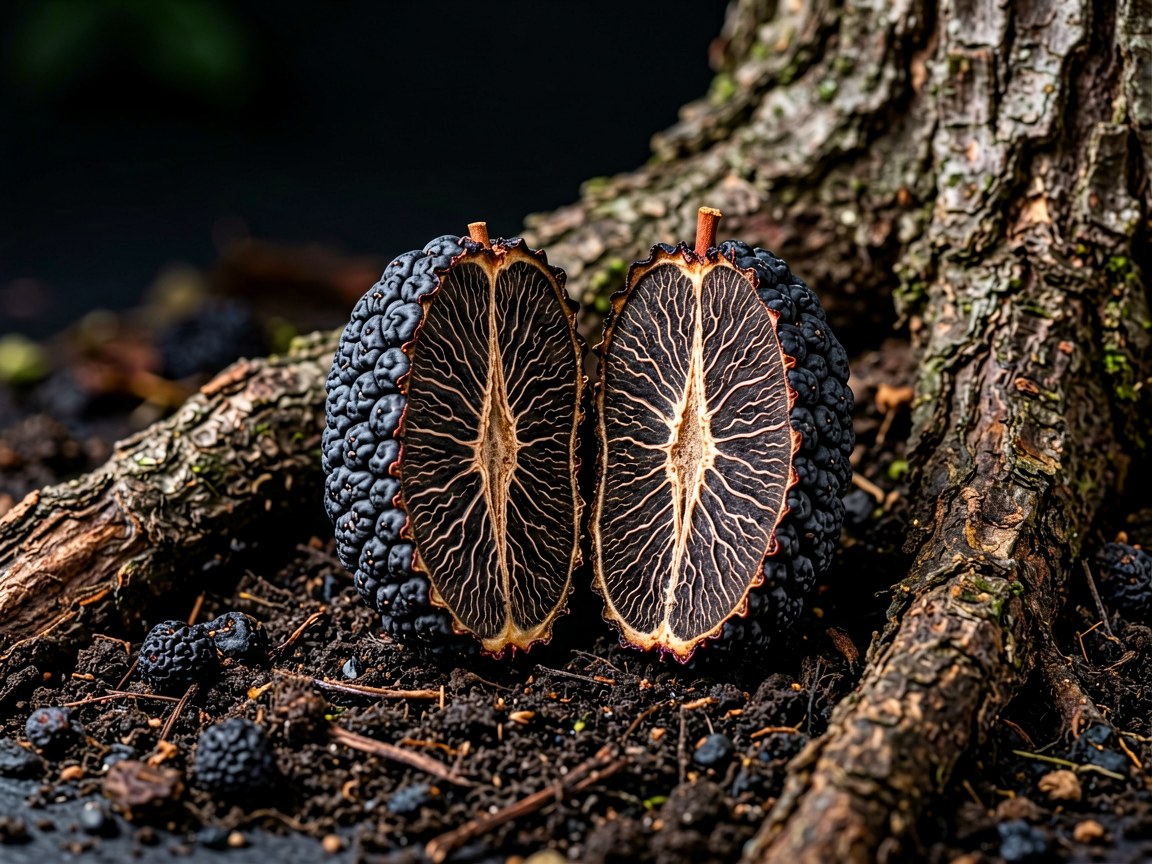
Tuber melanosporum | Black Truffle
Introduction
Tuber melanosporum, the black truffle or Périgord black truffle, is one of the most prized edible fungi in the world. Native to the limestone woodlands of southern France and northern Italy, it grows entirely underground in association with the roots of oaks, hazels, and other trees. For centuries its elusive, aromatic fruiting bodies have commanded prices higher than many luxury goods, earning it the title “black diamond” of cuisine. Unlike mushrooms that push above ground, the truffle matures hidden in the soil, and trained dogs or pigs are used to locate it by scent. Its intense, earthy aroma transforms sauces, oils, and dishes, and its cultivation has become a significant rural industry across temperate regions where the right host trees can be planted.
Taxonomy
Tuber melanosporum is the type species of the genus Tuber in the family Tuberaceae, an assemblage of subterranean ascomycete fungi. It is a close cousin of the Sparassis crispa (Cauliflower Fungus) and other edible fungi in the broader fungal tree of life, though truffles are unusual in ripening below ground. The genus name Tuber refers to the knob-like shape of the fruiting body, and “melanosporum” means “black-spored,” describing its dark internal veins. Truffles belong to the Pezizales, the cup-fungi, and their buried habit is a secondary adaptation: they lost the ability to fling spores into the air and instead rely on animals to unearth and eat them, dispersing the spores in dung.
Physical Characteristics
The black truffle is a rounded, lumpy tuber ranging from a walnut to a fist in size, with a rough, warty black exterior. Cut open, the flesh (gleba) is initially pale then darkens to grey-brown marbled with fine white veins, the mature spore-bearing tissue. It has a firm, dense texture and emits a powerful scent that humans describe as a blend of earth, chocolate, and musk. The fruiting body forms at depths of a few centimetres to over 30 cm, attached invisibly to fine host roots. Microscopically, its spores are ornamented and dark, suited to survive passage through an animal gut. There is no stem, cap, or gill—features are reduced to a potato-like mass specialised entirely for protection and spore production underground.
Habitats
Black truffles favour Mediterranean and warm-temperate climates with dry summers and mild, wet winters, on well-drained calcareous (lime-rich) soils. They fruit in the leaf litter and shallow soil beneath host trees such as holm oak, pubescent oak, hazel, and hornbeam, with which they form ectomycorrhizae. The association is mutualistic: the fungus extends the tree’s access to soil nutrients and water, while the tree supplies sugars from photosynthesis. Truffle grounds, called truffières, are traditionally managed open woodlands with little undergrowth, because the fungi need both the host’s shade and aeration of the soil. They do poorly in acidic, waterlogged, or heavily fertilised ground, which is why limestone hillsides of the Dordogne and Umbria remain classic truffle country.
Traditional truffière management keeps the tree canopy open and the ground clear of competing shrubs, because the fungus fruits best where soil stays cool and the host roots are not shaded out by understory plants. A thin leaf litter of oak and hazel is ideal, and growers often plant a mix of host species so that truffles can be harvested across a longer season as different trees flush. The species is sensitive to soil pH and will not fruit below about 7.0, which confines it to limestone and other calcareous geology. Irrigation is sometimes used in dry years to maintain the soil moisture the mycelium needs, but heavy fertiliser suppresses the symbiosis, so the best truffle grounds are low-input, traditionally managed woodlands rather than intensive plantations.
Diet
Tuber melanosporum is not a decomposer in the usual sense; it is a mycorrhizal symbiont that cannot live independently. It draws the carbon it needs—sugars and other organic compounds—from its host tree via the mycorrhizal connection, effectively “eating” what the tree manufactures by photosynthesis. In return, the fungus explores the soil with fine threads, scavenging minerals such as phosphorus and nitrogen and water that the tree roots alone could not reach efficiently. This exchange means the truffle is wholly dependent on a living plant partner and on the right soil chemistry. It does not rot wood or attack living tissue; rather, it is a quiet trading partner, and its rich flavour is a by-product of this hidden, underground economy between fungus and tree.
Because the truffle cannot photosynthesise, every carbon compound in its tissues originates from the host tree, making the partnership effectively a controlled exchange balanced by the fungus’s service as a nutrient-forager. The two partners trade continuously through the mycorrhizal mantle: the tree sends sugars down its roots, while the fungus extends a vast network of threads into the soil, accessing phosphorus, nitrogen, and trace metals the tree could not reach alone. Truffle orchards succeed only when this exchange is healthy, which is why over-fertilising or compacting the soil undermines production. Interestingly, the same aroma that attracts dogs and pigs may also recruit soil microbes that help suppress root pathogens, hinting that the symbiosis protects the tree as well as feeds the fungus. A failing truffière often shows the tree first, with yellowing leaves signalling the mycorrhizae have broken down.
Reproduction
The black truffle reproduces by spores formed inside the buried fruiting body. Because it cannot release spores into the air, it relies on animals—wild boar, rodents, and deer—to dig it up and eat it; the hardy spores pass through the gut and are deposited elsewhere, often near another suitable host root. Humans have largely taken over this role with trained dogs. Truffle orchards are established by planting host-tree seedlings whose roots have been inoculated with truffle spores in nurseries. After several years the fungus colonises the roots and begins to fruit, typically from late autumn to early spring. A truffière can produce for decades, but yields swing wildly with weather, soil moisture, and the age of the plantation.
Conservation
Tuber melanosporum is not at risk of extinction, but its wild populations have declined as traditional truffière management wanes and climate grows drier across its native range. The species is conserved economically rather than legally: thousands of hectares of truffle orchards have been planted across France, Italy, Spain, Australia, China, and the United States to meet demand. Wild harvesting is regulated by season and method in some regions to protect habitat. The greater conservation concern is preserving the calcareous woodland ecosystems and host-tree diversity that wild truffles depend on, since loss of those woodlands would erase the reservoir from which cultivated strains are drawn.
Fun Facts
- The black truffle grows completely underground and is found by scent-using dogs or historically pigs.
- It forms a mutualistic root partnership with oak and hazel trees, trading sugar for minerals.
- Its spores are spread when animals dig it up and eat it, passing through their digestive tract.
- A single truffle can be worth more per gram than many fine metals at market.
- Despite the high price, the fungus itself is a simple, potato-shaped mass with no stem or cap.