 By st20113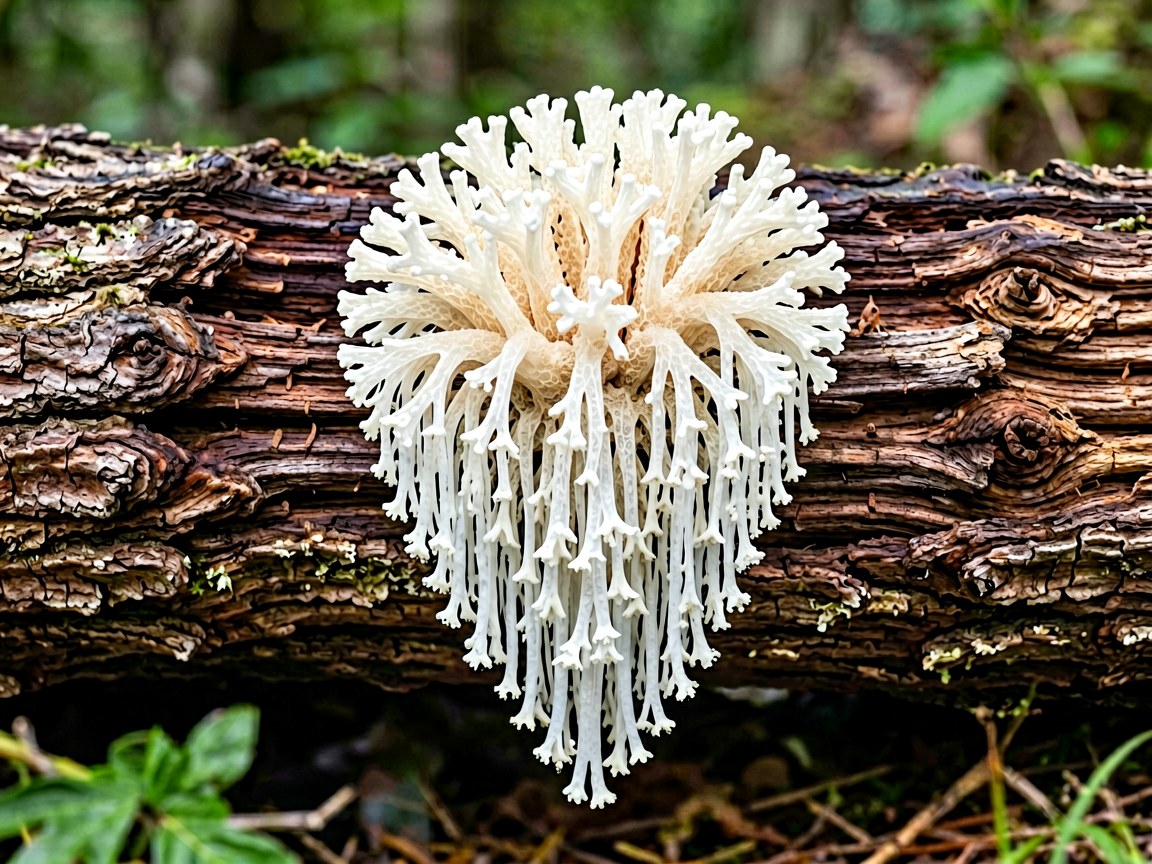
Hericium coralloides | Coral Tooth Fungus
Introduction
Hericium coralloides, the coral tooth fungus, is one of the most sculptural fungi of the broadleaved woodland, looking less like a mushroom than like a frozen white waterfall or a piece of coral sprouting from a fallen trunk. Instead of a cap and gills it bears cascading branches tipped with delicate hanging spines, pure white when fresh and creamy as it ages. A saprotrophic fungus, it lives on the dead wood of trees such as beech, birch and other hardwoods, breaking down the lignin and cellulose that hold timber together. It is prized as an edible delicacy with a seafood-like flavour and is also studied for medicinal compounds, and it is closely related to the better-known lion’s mane fungus. Because it depends on dead and dying timber in structurally diverse woodland, its presence is a welcome sign of the deadwood habitat that many creatures need, and it is considered uncommon rather than abundant. Long used in traditional medicine across Eurasia and now studied for compounds that may support nerve health, it has moved from forest floor to supplement shelf, which has increased pressure on wild populations even as cultivation expands. Its seafood-like taste has also made it a favourite of foragers and chefs, so a single well-placed log can yield both a meal and a lesson in how forests recycle their dead timber.
Taxonomy
The species belongs to the tooth fungus family, Hericiaceae, within the genus Hericium, a small group of white, spiny fungi that fruit on wood. Its epithet coralloides means “coral-like”, describing the branched form. It is distinguished from its famous relative Hericium erinaceus (lion’s mane) by having a branched, tree-like architecture with many points of attachment to the wood, whereas lion’s mane forms a single clustered clump of spines. Within the fungal tree of life it is a basidiomycete, the group that also includes the familiar gilled mushrooms, but it has abandoned gills entirely in favour of spines that carry the spore-producing surface. Like the fly agaric and other conspicuous woodland fungi, it is a product of the rich fungal community that recycles forest nutrients, though it does so as a decomposer rather than a mycorrhizal partner.
Physical Characteristics
The fruit body is 5–20 cm across and composed of repeatedly branching, flattened white arms that hang downward, each arm fringed at its tip with rows of slender, fragile spines 5–15 mm long. The overall effect is of fine white coral or a cascading fountain. The surface is soft and the flesh is white, firm andbrittle when young, becoming tougher and yellowing with age. There is no stem, cap or gills in the conventional sense; the spines themselves are where spores are formed. Fresh specimens are pure white and may weep slightly, while older ones turn cream, then buff, and eventually brown as they decay. Because the spines are so fine and dense, the fungus feels almost furry to the touch. A single fruit body can weigh several hundred grams on a large log, and its shape changes as it expands, sometimes looking like a tangle of icicles.
Habitat
Coral tooth fungus grows on dead or dying branches and trunks of broadleaved trees, showing a preference for beech but also occurring on birch, oak, maple, hornbeam and other hardwoods. It favours the shaded, moist microclimate of intact woodland where large dead branches and standing decaying timber are left in place, and it appears from late summer into late autumn. Across Europe it is widespread but local, and it occurs in temperate Asia and North America as well. It is essentially a species of wood decay, so it will not be found on the ground away from timber, nor on conifers in most regions. Because it needs substantial deadwood and the relative stability of old woodland, it is often treated as an indicator of high-quality, undisturbed forest with a natural deadwood cycle — exactly the kind of habitat that has become scarce in intensively managed woodland.
Diet
As a saprotrophic fungus, the coral tooth lives by decomposing dead wood. Its mycelium infiltrates fallen branches and trunks and secretes enzymes that break lignin and cellulose into simple sugars it can absorb, returning carbon and minerals locked in timber to the forest floor and the wider nutrient cycle. Unlike mycorrhizal fungi it does not partner with living roots; instead it is a recycler, finishing the work that the tree began in life by dismantling its remains. The fruiting body is the brief reproductive structure that the mycelium builds once it has colonised enough wood and the weather turns favourable. By rotting dead branches where they fall, the fungus helps keep the woodland floor open and releases nutrients for the next generation of plants, playing an essential if unseen role in forest health.
Reproduction
Reproduction is by spores formed along the hanging spines. When mature, the white spines shed enormous numbers of microscopic basidiospores that drift on the air to land on fresh dead wood. If conditions are suitably moist and the wood is of the right kind, the spore germinates and a new mycelium begins to colonise the timber, eventually fruiting when enough biomass has been broken down. Because the fungus is tied to dead hardwood, its spread is local and slow, following the availability of fallen branches and the continuity of suitable woodland. A single log may host the same mycelium for several seasons, producing new cascading fruit bodies each autumn until the wood is fully consumed and the fungus moves on.
Conservation
The coral tooth fungus is generally considered uncommon and is recorded as a species of conservation interest in several countries, partly because the deadwood-rich, unmanaged woodland it needs has become rare. It is not usually legally protected, but it benefits strongly from sympathetic forestry: leaving standing dead trees, retaining large fallen branches, and avoiding the clearance of “messy” woodland floor all help. In some regions it is threatened by the removal of deadwood for tidiness and by the loss of ancient beech forest. For foragers the guidance is to take only a little if any, and never from a single or small population, since over-picking can eliminate a local fruit body and the fungus is as valuable ecologically as it is on the plate.
Leaving dead branches in place is the simplest gift a woodland manager can give this sculptural recycler of timber.
Fun Facts
- It has no cap or gills — its spores form on hundreds of fine hanging spines like a white icicle fountain.
- It is prized in the kitchen for a flavour and texture often compared to crab or lobster meat.
- It is a close relative of lion’s mane fungus, which forms one solid clump rather than branched coral.
- The fungus recycles dead hardwood, helping release forest nutrients locked in timber.
- Its presence on a log is a good sign that the woodland retains the deadwood habitat many insects need.