 By st20113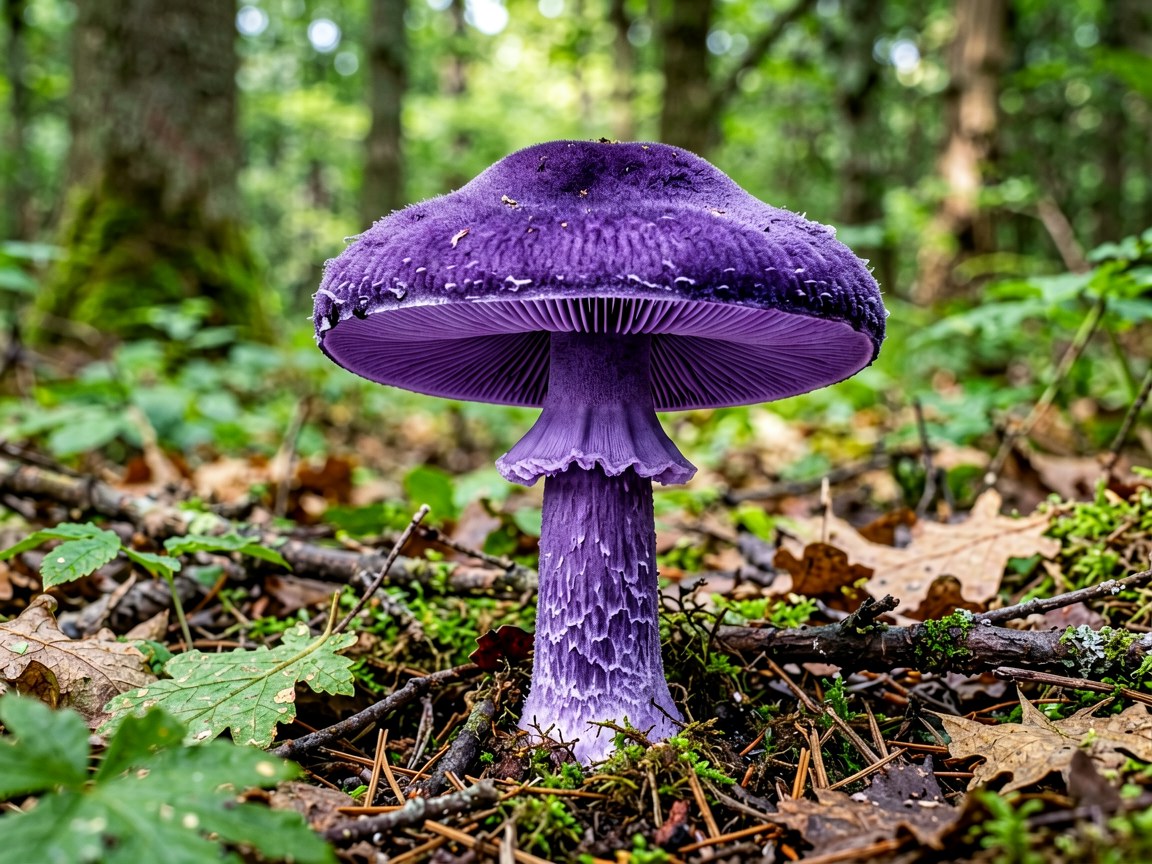
Cortinarius violaceus | Violet Webcap
Introduction
Cortinarius violaceus, the violet webcap, is one of the most striking fungi of the forest floor, clothed from cap to stem in a deep, velvety violet that few other mushrooms can match. A member of the vast genus Cortinarius — the largest genus of mushrooms in the world — it is a mycorrhizal species associated with deciduous trees, especially birch, beech and oak, on acidic, undisturbed soils. Its colour alone makes it unforgettable, and it has long been a favourite subject for fungal photographers. Although regarded as edible by some once well cooked, it is rarely collected because it is uncommon and because the genus as a whole contains dangerous look-alikes, so the sensible rule is to admire it in the field. The violet webcap is also of conservation interest: in several European countries it is declining with the loss of old, nutrient-poor woodlands and is afforded legal protection. Its range spans temperate Europe and temperate Asia, with scattered populations in northern North America, almost always on acidic, undisturbed soils beneath broadleaved trees. Because the genus contains deadly species, the violet webcap’s beauty is best enjoyed with the camera, and many countries that protect it do so not because it is rare everywhere but because old-woodland populations are slow to recover once their habitat is lost. It remains a prize sight for anyone walking quiet, mossy beech woods in early autumn.
Taxonomy
The species lies within Cortinarius, a genus of perhaps two thousand species defined by a cobweb-like partial veil (the “cortina”) that covers young gills and by rusty-brown spores. Its epithet violaceus simply means “violet-coloured”. It is grouped with the subgenus that has dry, fibrillose caps and a strongly violet overall hue. Like other forest fungi it is mycorrhizal, and in the same manner that the fly agaric partners with trees, the violet webcap exchanges soil minerals for tree sugars through root associations. Distinguishing it from other violet Cortinarii relies on its uniform deep colour, lack of any green or olive tint in age, and the rusty spore print that betrays its generic identity. Molecular work has confirmed it as a distinct species, though closely related violet forms have been split and renamed by specialists over the years.
Physical Characteristics
The cap is 5–15 cm across, at first rounded then broadening to flat or slightly umbonate, with a dry, finely fibrous surface that catches the light like velvet. Colour is a rich violet to purple-brown, fading somewhat with age and weather but remaining distinctly violet when young. The gills are initially violet, crowded and attached to the stem, later taking on rusty tones as the mature spores dust them. The stem is 5–12 cm tall, violet, solid and sometimes swollen at the base, with a faint cobweb veil when very young that soon disappears. Flesh is violet-tinged and firm. The spore print is rusty brown, the key feature separating the genus from the white-spored Russulas it might otherwise resemble. The whole fungus has a mild, not distinctive smell, and the striking monochrome violet is its clearest field mark.
Habitat
The violet webcap favours old, nutrient-poor, often mossy deciduous woodland, particularly under birch, beech, oak and sometimes pine on acid soils. It appears in late summer and autumn, typically as solitary fruit bodies or in small scattered groups on the forest floor rather than in dense rings. It is a species of continuity, doing best in long-undisturbed woodland with a deep, intact litter and humus layer, which is why it is often treated as an indicator of ancient or at least stable woodland. Across Europe it is widespread but nowhere abundant, and it extends into cooler parts of Asia and North America. It avoids fertile agricultural ground and lime-rich soils, and it is sensitive to changes in tree cover, drainage and nitrogen enrichment that simplify the forest floor and break the mycorrhizal web it depends on.
Diet
This is an ectomycorrhizal fungus, living in intimate contact with the fine roots of its host trees. The underground mycelium surrounds root tips and links them into a shared network that gathers water and mineral nutrients — especially nitrogen and phosphorus — from the soil and passes them to the tree in exchange for carbon sugars the tree fixes by photosynthesis. The mushroom flesh is therefore built, indirectly, from tree sugar. The fungus does not decompose wood or litter directly; instead it forages the soil with a far greater reach than roots alone, and both partners benefit on the acidic, low-nutrient sites it favours. The violet pigments are thought to be defensive, deterring grazing by mites and slugs that would otherwise consume the fruiting body before it can shed spores.
Reproduction
Reproduction is by spores produced on the gills. As the cap expands, the rusty-brown basidiospores are released in vast numbers and carried on air currents to new ground. Germination and the formation of a new mycorrhiza depend on a suitable host root being present, so the species is effectively confined to its tree partners’ range and to soils where those trees thrive. The cobweb veil protects the developing gills in youth, then breaks apart, leaving only faint traces on the stem. Because the violet webcap is tied to old woodland and produces relatively few fruit bodies, its populations rebuild slowly after disturbance, and a single mycelium may fruit in the same locality for many seasons as the underground network persists.
Conservation
Unlike many common woodland mushrooms, the violet webcap is of genuine conservation concern in parts of its range. It has declined across western Europe with the loss and fragmentation of ancient deciduous woodland, and it is listed as protected or priority in several countries, with picking restricted or banned. Its dependence on undisturbed, acidic, mycorrhiza-rich litter makes it slow to return once habitat is degraded, and atmospheric nitrogen deposition can shift the fungal community against it. Conservation centres on preserving old woodland, limiting fertiliser drift, and maintaining the natural tree mixture — especially birch and beech — that it partners with. For naturalists the message is clear: photograph it, learn it, and leave it in place so its fragile populations can persist.
Protecting the old, acidic woodland it needs is the surest way to keep this violet fungus a part of our autumn woods.
Where it still fruits, a single find can mark decades of undisturbed forest floor worth protecting.
Fun Facts
- It is among the very few mushrooms that are violet from cap to stem, giving it an almost regal appearance.
- The genus *Cortinarius* is the largest mushroom genus on Earth, with around two thousand species.
- Young caps are shielded by a cobweb-like veil, the feature that gives the genus its name.
- Its spores are rusty brown, a key clue that separates it from similar white-spored fungi.
- In several European countries it is legally protected because old-woodland habitat has shrunk.