 By st20113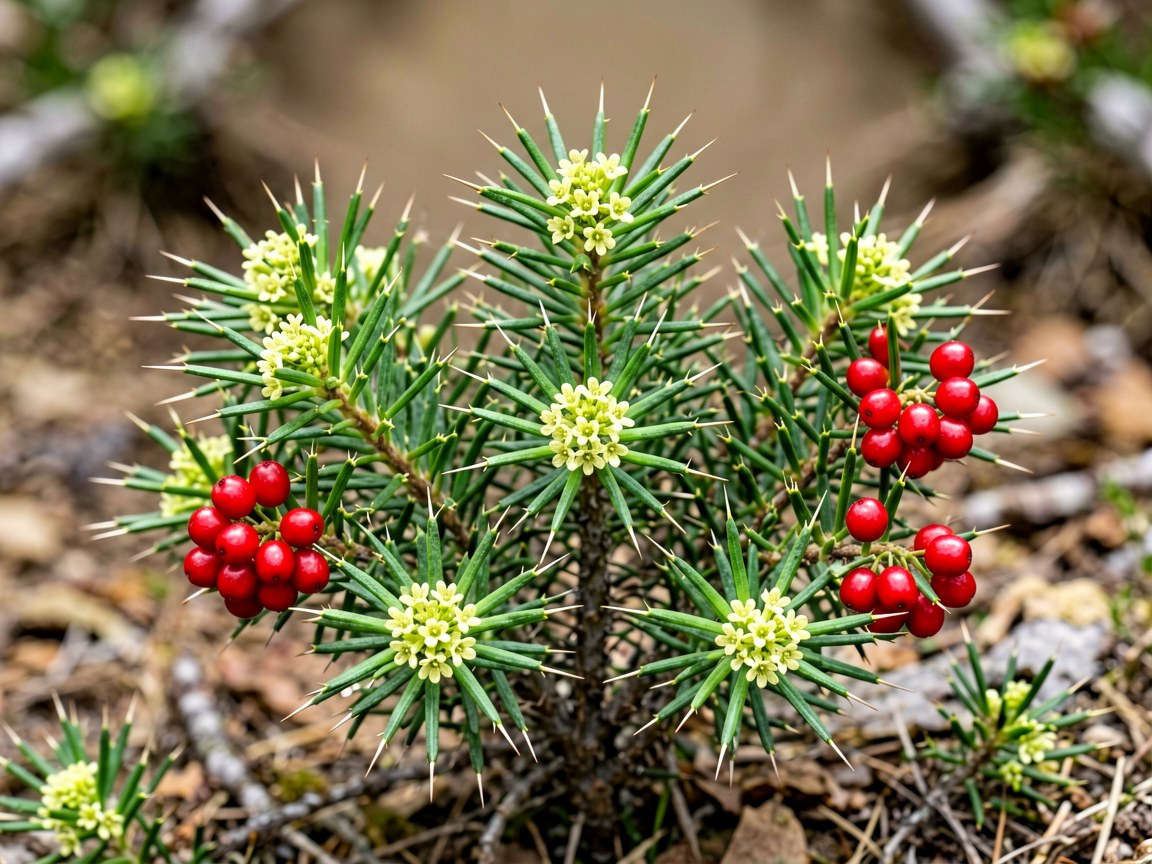
Ruscus aculeatus | Butcher’s Broom
Introduction
Butcher’s broom (Ruscus aculeatus) is a strange and unmistakable little evergreen shrub of woodland and scrub, and it is one of the few European plants whose flowers and fruit grow in the middle of its “leaves”. The leaves, as it turns out, are not leaves at all: they are flattened, leaf-like stems, or cladodes, each one stiff, leathery, dark green, and drawn out to a sharp, prickly point. The real leaves are tiny, papery scales that are barely noticeable, and the small greenish flowers appear singly on the middle of a cladode, followed by a handsome, shining, scarlet berry that sits, apparently, right on the leaf surface. It is a plant of southern woods and hedgebanks, long used in herbal medicine for the veins, and its stiff, spiny, long-lasting sprays were once bundled together and used to sweep a butcher’s block clean — the origin of its name.
Taxonomy
Ruscus aculeatus belongs to the family Asparagaceae, the asparagus family, a position that surprises people who know it as a shrubby, leafy thing; its relatives include asparagus, the lily-of-the-valley relatives, the Solomon’s seals, and the houseplants of the genus Asparagus, many of which have exactly the same trick of flattened, leaf-like stems. The genus Ruscus contains a handful of species distributed around the Mediterranean and western Asia, and this is the one that reaches north-west Europe. The specific epithet aculeatus means “prickly”, a reference to the sharp point of each cladode. It is dioecious, with male and female flowers on separate plants, which is unusual among British shrubs. As a green plant it depends on Photosynthesis, and here the assimilation is done by the flattened stems rather than by true leaves, an arrangement that conserves water and suits the dry, shady woodland floor the plant prefers.
Physical Characteristics
It is a small, evergreen, much-branched, upright subshrub, usually thirty to eighty centimetres tall, arising from a creeping, branching rhizome and often forming dense clumps. The stems are green, stiff, and ridged, and they bear numerous alternate, flattened, leaf-like cladodes: each is oval to lance-shaped with a long, tapering, sharply pointed tip, two to five centimetres long, very stiff and leathery, dark glossy green above and paler beneath, with fine parallel veins. The true leaves are minute, brownish, papery scales at the base of each cladode and are easily overlooked. The flowers are small, about five millimetres across, and are borne singly or in pairs on the middle of the upper surface of a cladode, apparently sitting on the “leaf”; they have six greenish-white to purplish segments, the three inner ones much narrower than the outer, and in the female flowers there is a conspicuous central, flask-shaped ovary. The fruit is a globular, shining, bright scarlet berry, eight to fifteen millimetres across, containing one or two large, hard seeds. Flowering is from January to April, and the berries ripen through the autumn and often persist well into the winter.
Habitat
It grows in woodland, particularly dry woodland on base-rich soils, in scrub, on hedge banks, in rocky places, on sea cliffs, and among the shade of old gardens and churchyards, and it is most characteristic of the warm, dry, calcareous woodland of southern and western Europe. It is remarkably tolerant of deep shade and of dry soil, and it will grow under a closed canopy of beech or oak where little else survives, which is a consequence of its evergreen habit and of the efficiency of its flattened stems. The species is distributed across western and southern Europe, north Africa, and western Asia, and it reaches the northern limit of its range in southern England and Wales, where it is native but local, and it is planted and occasionally naturalised elsewhere. It is one of the characteristic plants of the scrub and woodland of chalk and limestone country.
Diet
Butcher’s broom is autotrophic, and all of the photosynthesis is carried out by the green stems and by the flattened cladodes, since the true leaves are reduced to insignificant scales. This is an adaptation shared with a number of plants of dry or seasonally dry habitats: by reducing the leaves and moving the work of assimilation into the stem, the plant cuts the surface from which water can be lost while keeping a large area for capturing light. It is not a demanding feeder, and it grows on moderately fertile but often shallow and dry soils, relying on a deep, creeping rhizome to reach moisture and to store reserves. It associates with mycorrhizal fungi in the soil. Its chemistry has attracted a great deal of attention: the rhizome and roots contain steroidal saponins, principally ruscogenin, which are the basis of its long-standing medicinal use and which are also thought to defend the underground parts against fungi and soil animals.
Reproduction
The plant is dioecious, so male and female flowers are on separate individuals and both are needed for fruit to be produced — a scarce male plant in a wood may mean that a large female colony sets little or no fruit. The flowers are small and inconspicuous and are pollinated by insects, chiefly by early bees and by flies, which visit them for what little nectar they produce; flowering in the depths of winter means that the number of available pollinators is small and that fruiting is often poor in cold seasons. Once fertilised, the ovary develops into the bright red berry, which ripens through the summer and autumn. The berries are attractive to birds, particularly thrushes and blackbirds, which swallow them and void the hard seeds elsewhere, and this is the main means of dispersal. The plant also spreads vegetatively by means of its creeping, branching rhizome, and a colony in a wood is frequently a single, slowly expanding clone.
Conservation
The species is not globally threatened and is abundant in the warmer parts of its range, but it is at the northern edge of its distribution in Britain, where it is local and considered of conservation interest in some counties; it is protected under law in Britain against uprooting, and the trade in wild-collected plants is restricted. Its British sites are mostly in ancient woodland on chalk and limestone, and the threats they face are the destruction and fragmentation of that woodland, the removal of the shrub layer, heavy browsing by deer, which can eliminate it entirely, and the collection of plants for the horticultural and cut-foliage trades. Because it is slow-growing and long-lived and because its colonies spread so slowly, a lost colony is not quickly replaced.
Fun Facts
- The “leaves” are actually flattened stems, and the flower sits in the middle of one.
- It is dioecious: male and female flowers are on separate plants, so a lone plant never berries.
- The stiff, spiny sprays were once bundled together and used to scrub a butcher’s chopping block.
- Extracts of the root are still used for the treatment of varicose veins and haemorrhoids.
- It flowers in the depths of winter, from January to April, and the red berries last into the following year.