 By st20113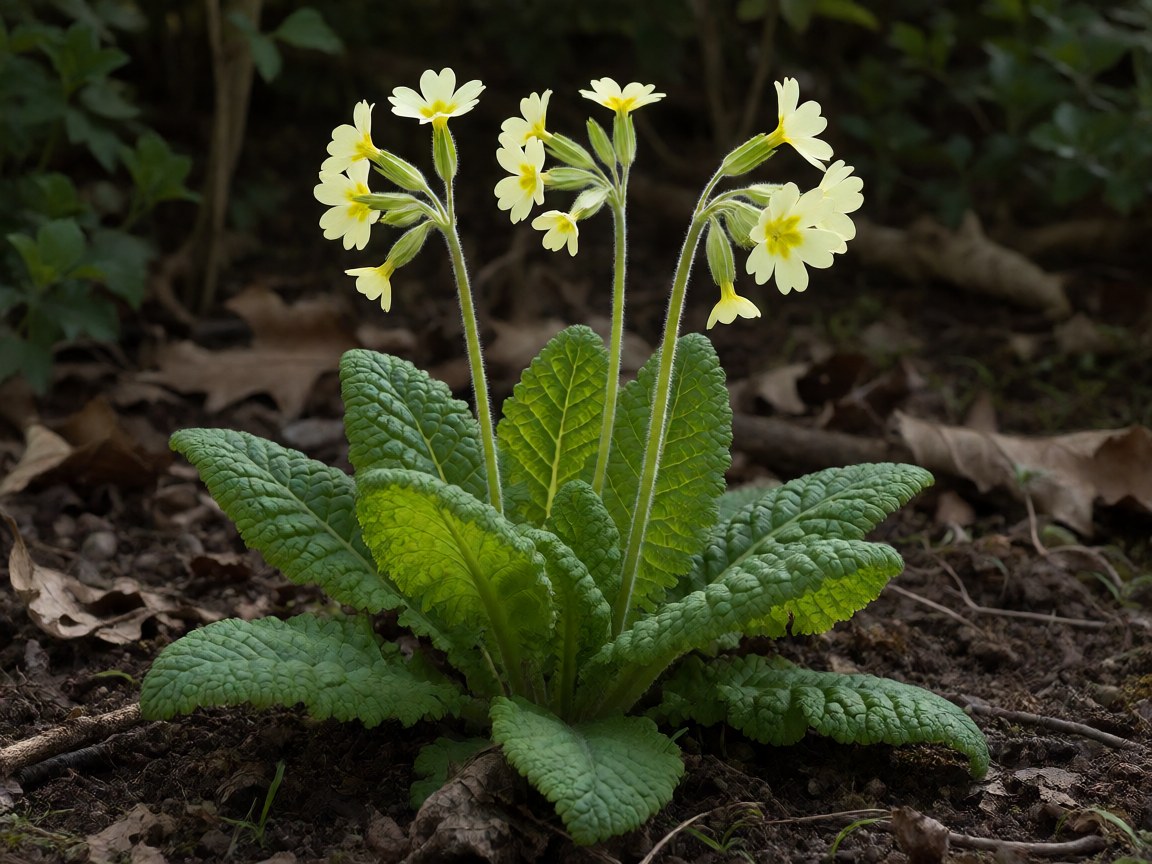
Primula vulgaris | Primrose
Introduction
The primrose (Primula vulgaris) is one of the first and best-loved flowers of the year: a low rosette of crinkled, tongue-shaped leaves carrying soft pale-yellow flowers on single slender stems. It blooms from late winter into spring on woodland banks, hedgerows, and grassy slopes, and it is one of the earliest nectar sources for insects waking from winter. Few wildflowers are as closely tied in popular imagination to the arrival of spring.
Taxonomy
Primula vulgaris belongs to the family Primulaceae, the primrose family, and is the type species of the genus Primula, which contains several hundred primroses, cowslips, and primulas worldwide. It is a perennial herb rather than a bulb, dying back to a rootstock in summer. As a green plant it feeds by Photosynthesis, and its early flowering is possible because the evergreen rosette of leaves begins gathering light as soon as the days lengthen, long before the woodland canopy closes.
Physical Characteristics
The plant forms a low rosette of oblong, tongue-shaped leaves, five to twenty centimetres long, blunt-tipped, strongly wrinkled and veined, with wavy edges that narrow towards the base. The flowers rise individually on separate downy stalks three to twelve centimetres tall, each two to three centimetres across with five pale yellow, notched petals and a deeper yellow eye. A notable feature is that primroses show two flower forms on different plants—pin-eyed and thrum-eyed—which helps ensure cross-pollination.
Habitat
Primroses grow in woodland, on hedgebanks, shady lanes, grassy slopes, cliff tops, and churchyards, usually on moist but well-drained, slightly heavy soils. They are found across Europe, north Africa, and western Asia. They favour light shade and are typical of ancient woodland and old hedgerows, where they spread slowly into loose colonies. In hot, dry summers the leaves die back almost completely and the plant rests.
Diet
It is autotrophic, photosynthesising in its evergreen rosette, which begins working in late winter and continues into early summer before the plant retreats underground. Because it grows and flowers so early, it depends on reserves stored in the short, thick rootstock from the previous year. It partners with soil fungi that help it take up nutrients, and it takes no nourishment from animals.
Reproduction
The two flower forms—long-styled “pin” flowers and short-styled “thrum” flowers—place pollen and stigma at different heights, so pollen is picked up from one form and deposited on the other by bees, beetles, and flies. This arrangement, called heterostyly, strongly encourages cross-pollination between different plants. After flowering, small capsules release numerous tiny seeds near the parent plant, and established clumps also spread slowly by short, branching rootstocks.
Conservation
The species is still widespread and common, but it has declined in places through the loss of ancient woodland and old species-rich hedgerows, intensification of grazing, and heavy picking. It is protected against uprooting by law in some countries. Because plants are slow to colonise new sites, primrose is often used as one of the indicator species that mark old, undisturbed woodland or grassland.
Fun Facts
- Primrose flowers come in two forms on different plants, a neat trick that encourages cross-pollination.
- The name *Primula* means “little first one”, for its very early flowering.
- It is one of the first nectar sources of the year for early bees and hoverflies.
- Wild primroses are pale yellow; the bright coloured “primroses” sold in shops are hybrids.
- In Devon and Cornwall the flower is traditionally used to decorate wells and springs.
[…] also spreads through the cooler north. The cowslip is the close relative of the Primrose (Primula vulgaris). That plant belongs to the same genus. Its pale yellow flowers sit alone on their own stalks. The […]