 By st20113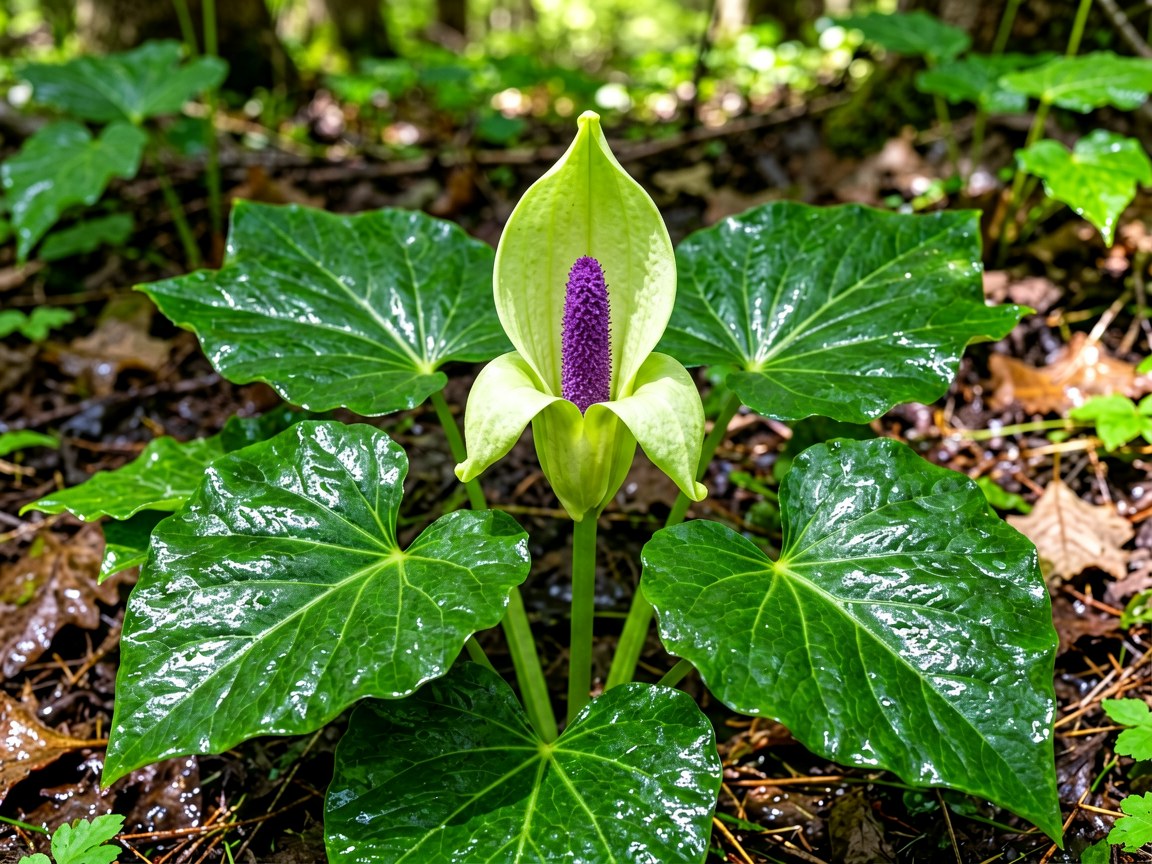
Arum maculatum | Lords-and-Ladies
Introduction
Lords-and-ladies (Arum maculatum) is the curious woodland plant of spring hedgerows, best known for its pale green hooded flower spike and its poker of glossy orange-red berries in autumn. Also called cuckoo-pint, wild arum, or jack-in-the-pulpit, it pushes up glossy arrow-shaped leaves early in the year and then quietly dies back by midsummer. Every part of it is poisonous, yet it is one of the most distinctive and easily recognised wildflowers of European woods.
Taxonomy
Arum maculatum belongs to the family Araceae, the arums or aroids, a group that also includes the cultivated calla lilies and the giant titan arum. Its “flower” is in fact an inflorescence—a spike of many tiny flowers wrapped in a leafy bract. As with every green plant, its big glossy leaves exist to run Photosynthesis, building the starch that it packs into an underground tuber so it can race through its whole life cycle before the trees close overhead.
Physical Characteristics
The plant grows twenty to forty centimetres tall from a rounded, starchy underground tuber. Its leaves are large, glossy, and arrow- or spear-shaped, often marked with dark purple blotches, and they unfurl in early spring. The inflorescence is a pale yellow-green hood, or spathe, ten to twenty-five centimetres long, curled around a central rod called the spadix that is purple at the tip and ringed at the base by tiny male and female flowers. In late summer the spathe withers and the spadix becomes a tight cylinder of brilliant orange-red berries.
Habitat
Lords-and-ladies is a plant of deciduous woodland, hedgerows, shady banks, and churchyards, especially on moist, fertile, lime-rich soils. It is common across most of Europe and into western Asia and has been introduced elsewhere. It favours the dappled shade of spring, completing its growth while the canopy is still open, and it often forms loose colonies in old, undisturbed woods where the leaf litter is deep.
Diet
The plant feeds itself entirely by photosynthesis, using its broad spring leaves to capture the light that reaches the woodland floor before the trees come into full leaf. The sugars it makes are stored in the tuber, which funds the next year’s growth and the costly production of berries. Like many woodland spring plants it is a “spring ephemeral” in behaviour, packing a full season of feeding into a few short months and then retreating underground.
Reproduction
The inflorescence works as a small temporary trap. It gives off a faint, unpleasant scent and generates heat, drawing in small flies and midges that slip down the slippery spathe onto the flowers, where they deposit pollen picked up elsewhere. After fertilisation the tiny flowers swell into a spike of orange-red berries, each holding one or two seeds. Birds eat and disperse them, though the berries are toxic to people. The plant also creeps slowly through the soil by dividing its tuber.
Conservation
Arum maculatum is widespread and common and is not considered threatened. Because it depends on old, shady woodland and undisturbed hedgerow soils, it can decline where ancient woods are cleared, ploughed, or heavily disturbed, and it is slow to recolonise new sites. It is generally secure, however, and is a familiar and stable part of the spring flora across most of its range.
Fun Facts
- The plant heats itself: the spadix can run several degrees warmer than the air, helping its scent carry to flies.
- Its many folk names—cuckoo-pint, lords-and-ladies, jack-in-the-pulpit—all describe the hooded flower shape.
- Every part of the plant is poisonous, containing needle-sharp crystals, and the berries are especially dangerous.
- The starchy tuber was once dried and ground into a flour called Portland sago, after repeated washing removed the toxins.
- The glossy red-brown berries ripen in autumn and are one of the brightest things on a shady woodland floor.