 By st20113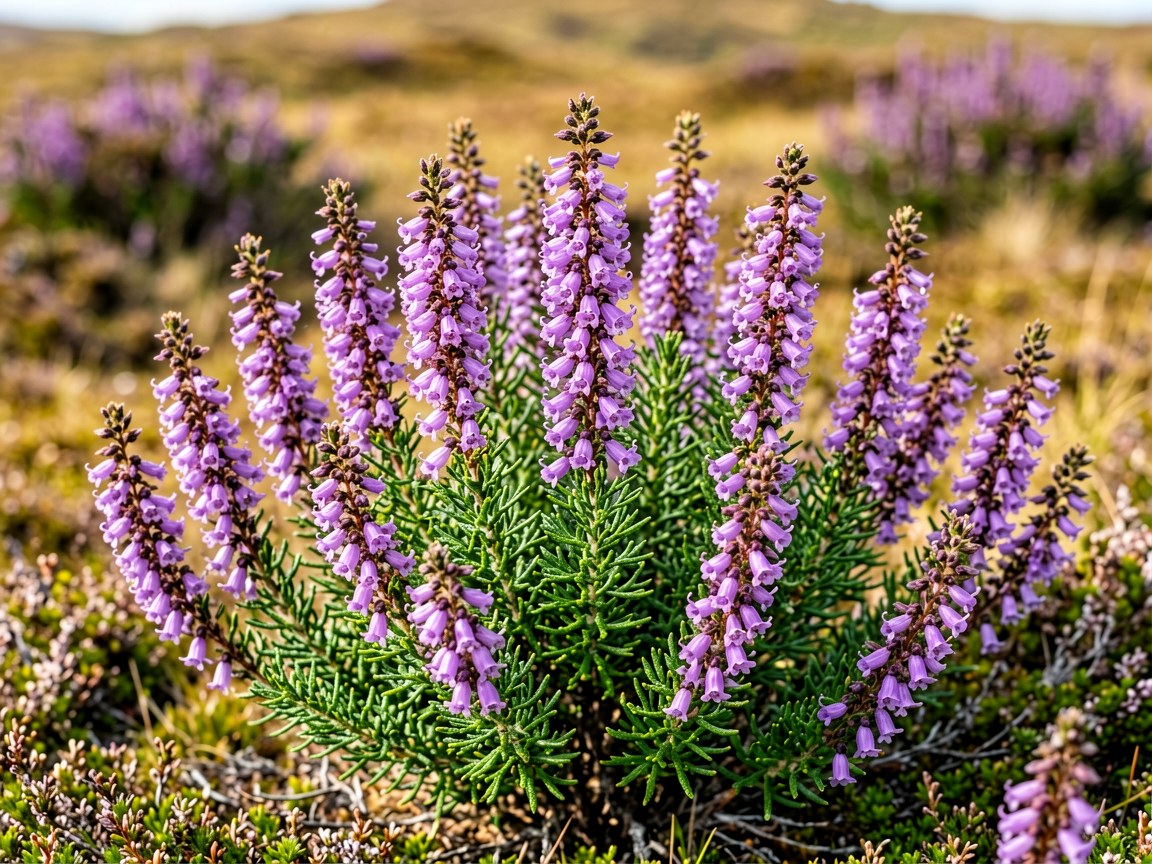
Calluna vulgaris | Heather
Introduction
Heather (Calluna vulgaris) is the small, tough evergreen shrub that turns whole moors and heaths purple in late summer. Barely knee-high in exposed places and up to a metre where sheltered, it forms dense, springy carpets across acidic soils from Ireland to Siberia. Its bell-shaped flowers are a last great nectar source of the year for bees, and the plant has shaped—and been shaped by—the grazing, burning, and walking that define northern heathland.
Taxonomy
Calluna vulgaris is the sole species in its genus and belongs to the family Ericaceae, the heath family, which also includes the heaths, rhododendrons, and bilberries. Like its relatives it thrives on poor acid soils with the help of root fungi. As a green plant it depends on Photosynthesis, its tiny overlapping leaves working year-round to turn sunlight into the sugars that fuel a very slow, tough kind of growth.
Physical Characteristics
Heather is a much-branched evergreen shrub usually twenty to fifty centimetres tall, occasionally reaching a metre. Its leaves are minute, only two or three millimetres long, scale-like and pressed against the stem in four rows, each pair fused at the base to form a small sheath—a shape that cuts water loss in wind and drought. From late July to September the shoots carry dense one-sided spikes of bell-shaped flowers, typically mauve-pink but ranging through white in some forms. The woody stems are wiry and the whole plant feels rough and springy underfoot.
Habitat
Heather dominates dry and damp heaths, moorland, bogs, and open acidic woodland across Europe and into western Asia, and has been introduced to North America and New Zealand. It needs acidic, nutrient-poor, freely draining soil and open, sunny conditions; it cannot compete with grasses or trees on richer ground. Traditional management—light grazing by sheep and grouse, and controlled burning on long rotations—keeps it young and productive, and it is the plant that defines the purple moorland landscape.
Diet
Heather is autotrophic, feeding itself through photosynthesis in its small evergreen leaves, which can work whenever temperatures allow rather than only in summer. Because its soils are so poor, it gets crucial help from ericoid mycorrhizal fungi in its roots, which break down tough organic matter and release nitrogen the plant could not otherwise reach. This partnership lets heather thrive where most other shrubs would starve. It consumes nothing from animals, though grazing shapes the habitat it lives in.
Reproduction
The bell-shaped flowers open from late summer and are pollinated mainly by bees, flies, and other insects drawn to the abundant nectar; heather honey is a valued late-season crop. Each flower sets a small capsule packed with minute seeds that scatter close to the parent plant. Heather also spreads vegetatively: low branches touch the ground, root, and build outward, so a single plant can slowly form a spreading patch. After fire, seeds lying in the soil germinate readily on the cleared, ash-enriched ground.
Conservation
Heather is abundant and not globally threatened, but heathland itself—the habitat it defines—has shrunk dramatically across Europe through agricultural improvement, forestry, development, and neglect. Much remaining heath is fragmented, and both abandonment and over-grazing damage it. Conservation bodies restore heath by clearing scrub and trees, reintroducing grazing, and recreating the open conditions the plant needs. In places heather is carefully managed for grouse shooting, which maintains young, flowering growth.
Fun Facts
- Heather is the sole species in its genus, making it unique rather than just one of many.
- Its scientific name comes from the Greek *kallyno*, “to sweep or cleanse”—heather twigs were tied into brushes and brooms.
- White heather is considered lucky in Scotland, where sprigs are still given as tokens.
- Heather honey is thick, amber, and strongly flavoured, and is one of the last harvests of the beekeeping year.
- The plant can live for several decades and its woody stems were once used for thatching, bedding, and even dyeing wool yellow.
[…] The species sits in the family Ericaceae. Its order is the Ericales. The genus Vaccinium holds about 450 species in all. It shares the family with the Heather. […]