 By st20113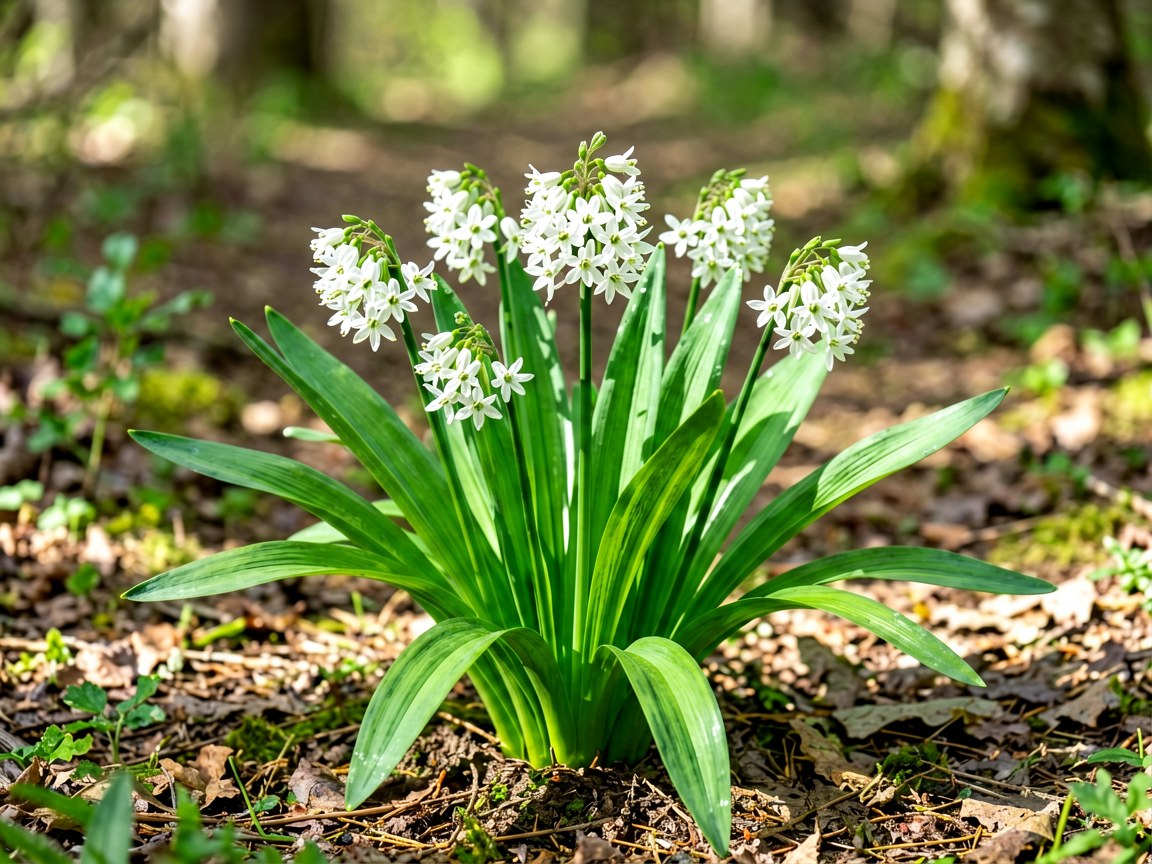
Allium ursinum | Wild Garlic
Introduction
Wild garlic (Allium ursinum), also called ramsons or bear’s garlic, is a spring-flowering bulb that carpets damp, shady woodland with brilliant green leaves and clouds of starry white flowers. Its broad, soft leaves smell powerfully of garlic when crushed, and in late spring a wood full of ramsons can be scented from many metres away. It is one of the most reliable indicators of ancient woodland and one of the most foraged wild foods in Europe.
Taxonomy
Allium ursinum belongs to the family Amaryllidaceae within the order Asparagales, the same family as daffodils, and formerly placed in its own family Alliaceae. The genus Allium includes onions, leeks, and chives, and the species name ursinum means “of bears”—the plant is sometimes called bear’s garlic, apparently because bears were said to dig and eat the bulbs. Like all green plants it is powered by Photosynthesis, which fuels its rapid spring growth before the canopy closes.
Physical Characteristics
Each plant grows from a narrow, elongated bulb and produces two or three bright green, elliptical, stalked leaves 10–25 cm long, which are soft, smooth, and unmistakably garlic-scented when bruised. In April and May a single leafless, three-angled flowering stem rises 15–45 cm, topped with a loose umbel of six to twenty pure white, six-petaled, star-shaped flowers. The whole plant dies back to the bulb by early summer, often before the tree canopy is fully closed.
Habitat
Wild garlic favours moist, humus-rich, slightly base-rich soils in shady deciduous woodland, particularly ancient woods, and often along streams and in damp hollows. It spreads to form dense, almost pure carpets covering the woodland floor in spring. Because it spreads slowly and colonises new woodland poorly, large stands are a strong signal that a wood is old. In some regions outside its native range it has become invasive.
Diet
The plant is photosynthetic, manufacturing its own sugars from sunlight, water, and carbon dioxide and drawing nutrients from the rich woodland soil through its fibrous roots. It takes nothing from other organisms. Ecologically it is important in the other direction: its early, abundant nectar and pollen are valuable to bees and hoverflies at a time when woodland flowers are scarce.
Reproduction
Wild garlic reproduces both by seed and vegetatively. The white flowers are insect-pollinated, mainly by bees and flies, and each produces a small black seed. The seeds carry a fleshy, oil-rich appendage called an elaiosome, which ants find irresistible; they carry the seeds away and eat the appendage, effectively planting the seed—a dispersal method known as myrmecochory. The bulbs also divide, which is how the extensive carpets form.
Conservation
Wild garlic is common and not threatened, but two things matter for its protection. Because huge stands are a hallmark of ancient woodland, they are best appreciated and not dug up, and in some areas commercial-scale picking is discouraged. Foragers should also be careful: the leaves closely resemble those of lily-of-the-valley and cuckoo pint, both of which are poisonous, though the garlic smell is a decisive test.
Fun Facts
- The species name means “of bears”—it is sometimes called bear’s garlic.
- Its seeds are dispersed by ants, which carry them off for their oily appendages.
- A large stand of wild garlic is a classic indicator of ancient woodland.
- The leaves can be mistaken for poisonous lily-of-the-valley, but crushing them gives an unmistakable garlic smell.
- Whole woods can smell strongly of garlic in spring, sometimes from many metres away.