 By st20113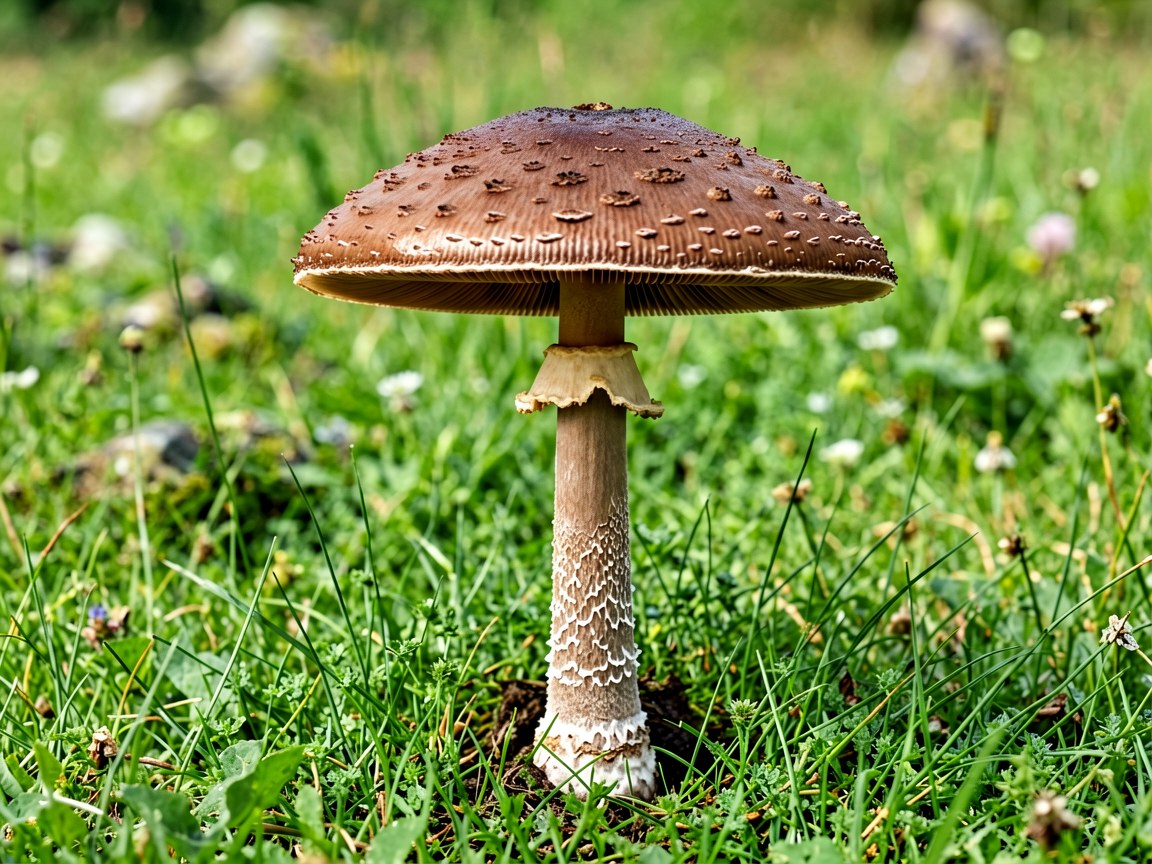
Macrolepiota procera | Parasol Mushroom
Introduction
The parasol mushroom (Macrolepiota procera) is one of the largest and most stately fungi of European grasslands, sending up a tall, slender stem topped by a broad, scaly, umbrella-shaped cap. A single specimen can reach 40 cm across and stand 30 cm tall, appearing in meadows, hedgerows, and woodland edges in late summer and autumn. It is a prized edible species, but foragers must be careful: it resembles several toxic relatives.
Taxonomy
Macrolepiota procera belongs to the family Agaricaceae within the order Agaricales, in the phylum Basidiomycota—the same large fungal group that includes Amanita muscaria (Fly Agaric). The genus name means “large scale,” referring to the conspicuous scales on the cap, while the species name procera means “tall.” It was formerly placed in the genus Lepiota before being separated on account of its much larger size and movable ring.
Physical Characteristics
The cap begins egg-shaped and enclosed, then expands into a broad, flat, parasol-like umbrella, typically 10–30 cm across and occasionally reaching 40 cm. Its surface is pale cream to white, broken into coarse brown scales arranged in concentric rings, with a darker, smooth, raised center known as an umbo. The gills are free, crowded, and white to pale cream. The slender stem is 15–30 cm tall with a bulbous base, patterned with fine brown bands, and bears a thick, double-edged ring that—unlike most mushrooms—can be slid up and down the stem. The spore print is white.
Habitat
This species is saprotrophic, feeding on dead organic matter in the soil rather than partnering with tree roots. It grows in grassy places: meadows, pastures, roadside verges, hedgerows, woodland clearings, and gardens, and it frequently appears in troops, arcs, or fairy rings. It favors well-drained, undisturbed, unimproved grassland and fruits from late summer into late autumn.
Diet
As a saprotroph, the parasol mushroom obtains its nourishment by breaking down dead plant material in the soil. Its mycelium secretes enzymes that decompose leaf litter, dead roots, and other organic debris, releasing nutrients that the fungus absorbs. In doing so it plays an important role in nutrient cycling and soil formation, returning locked-up carbon and minerals to the grassland ecosystem.
Reproduction
The mycelium lives underground year-round and produces the familiar mushroom only when temperature and moisture are right. Spores are formed on the gills and released in enormous numbers to be carried off by wind. If a spore lands in suitable soil with enough organic matter, it germinates and establishes a new mycelium. The expanding mycelium grows outward in a circle, which is why the fruiting bodies often appear in rings year after year, each ring slightly larger than the last.
Conservation
The parasol mushroom is common and not threatened, though the unimproved, lightly managed grasslands it favors have declined sharply across Europe. Since it is a decomposer rather than a mycorrhizal partner, its fortunes are tied to the health of permanent grassland and to the avoidance of ploughing, reseeding, and heavy fertilizer use. In some countries it is legally protected against indiscriminate commercial picking.
Fun Facts
- Its ring is famously loose: you can slide it up and down the stem like a curtain ring.
- The cap can reach 40 cm across—wide enough to use as an impromptu plate.
- The white spore print is a key safety check: the poisonous look-alike Chlorophyllum molybdites has green spores.
- It often fruits in fairy rings that reappear in the same spot for decades, expanding a little each year.
- Only the cap and upper stem are eaten; the tough, fibrous lower stem is usually discarded.