 By st20113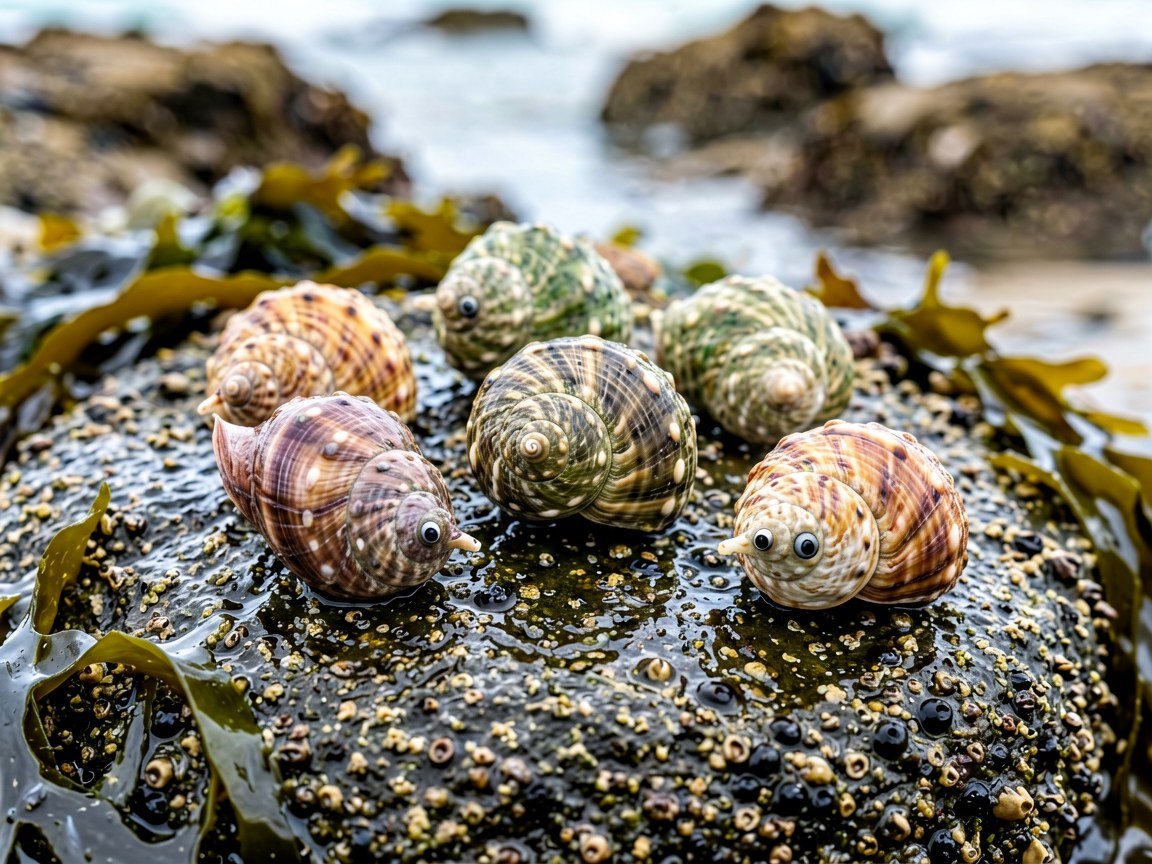
Littorina littorea | Common Periwinkle
Introduction
The Common Periwinkle (Littorina littorea) is a small but immensely abundant sea snail of the North Atlantic shore, the rounded, dark shell that most beachcombers have turned over in their hands countless times. Reaching 2–3 cm, it clings in dense crowds to rocks in the intertidal zone, and has been a familiar source of food, bait, and natural history wonder along European coasts for centuries.
Tough, patient, and superbly adapted to the daily violence of the tide, the periwinkle is one of the most successful animals of the rocky shore. Where waves crash and the air temperature swings with the tide, it simply seals itself in and waits—making it an ideal ambassador for the strange, half-land half-sea world of the intertidal.
Taxonomy
Littorina littorea was described by Linnaeus in 1758; the genus name Littorina means “of the shore,” and littorea means “of the seashore.” It belongs to the family Littorinidae, within the great class Gastropoda—the snails and slugs—and is a true marine mollusc with a coiled shell and a muscular foot.
Like the common octopus, described in our article on Octopus vulgaris (Common Octopus), the periwinkle is a mollusc, but where the octopus is a soft-bodied cephalopod master of intelligence and Ink, the periwinkle is a humble gastropod that has traded freedom of movement for the protection of a permanent, portable shell. The two represent opposite ends of the molluscan spectrum.
Physical Characteristics
The Common Periwinkle’s shell is thick, conical, and spiralled, typically 10–30 mm tall, in shades of grey, olive, or dark brown, with five to seven whorls and a small, pointed spire. The shell opening is closed by a tough, horny operculum that the snail draws shut behind it, sealing in moisture when the tide retreats.
The animal itself has a dark head with two pairs of tentacles, the longer pair bearing eyes at their bases, and a broad muscular foot used to grip rock and creep slowly forward. A rasping tongue-like radula armed with thousands of tiny teeth scrapes food from surfaces, and the snail can right itself and re-attach within seconds if dislodged by a wave.
Habitat
Periwinkles occupy the full height of the intertidal shore, from the upper rocks scoured only by the highest tides down to the shallow sub-tidal, favouring exposed and moderately exposed rocky coasts, boulders, and stable cobble where they can hold on against the surf. They also occur in estuaries and on salt marshes, tolerating a wide range of salinity.
Their secret is toughness: a wave-exposed life demands both a grip and a tolerance of being left high and dry. By clamping down and sealing the operculum, a periwinkle can survive many hours out of water, riding out heat, cold, and desiccation between tides, then resuming feeding as soon as the sea returns. This resilience lets them outperform thin-shelled competitors on the most punishing shores.
Diet
The Common Periwinkle is a grazer, feeding mainly on the films of microscopic algae, diatoms, and bacteria that coat rocks, and on the youthful stages of larger seaweeds. Using its radula like a file, it scrapes this “biofilm” from the surface, often leaving faint grazing trails across the stone.
Although tiny, periwinkles are collectively important gardeners of the shore: by cropping algae they help prevent any single seaweed from smothering the rock, and their constant grazing shapes the look of the intertidal community. In turn they are food for shorebirds such as oystercatchers and for crabs and whelks, placing them squarely in the middle of the shore’s food web.
Reproduction
Unusually for a shore snail, Littorina littorea is ovoviviparous: instead of shedding eggs into the sea to drift as larvae, the female broods her eggs internally and releases fully formed, crawling juvenile snails—already miniature periwinkles—directly onto the shore. This gives the young a far better start than free-floating larvae, which would be scattered and eaten.
The species has separate sexes, and mating takes place on the shore. Because the young bypass the vulnerable planktonic stage, populations can build up steadily even in sheltered spots, and the snail has become one of the most numerous animals of the temperate North Atlantic coast—so numerous, in fact, that it was transported (likely in ballast or as bait) to North America, where it is now established.
Conservation
The Common Periwinkle is abundant and listed as Least Concern across most of its native range, and it supports a long tradition of hand harvesting for food and bait. Local concern arises only where collection is intense or where shore habitat is damaged by coastal development and pollution.
In areas where it has been introduced, such as parts of the north-eastern United States and Canada, it can reach very high densities and is watched as a potential competitor with native snails. Management is light-touch in Europe—limits on gathering in some reserves and an general reliance on its natural productivity—while the bigger story is the pressure of warming seas and acidification on the algae and crabs that frame its world.
Fun Facts
- A periwinkle can seal its shell with its operculum and survive out of water for many hours, shrugging off sun and drying wind between tides.
- It has been eaten along European coasts since prehistoric times; its shells litter ancient kitchen middens.
- Despite being a snail, it broods live young and releases them as tiny crawling snails, not drifting larvae.
- Its radula carries thousands of microscopic teeth it uses like sandpaper to scrape algae off rock.
- Accidentally carried to North America, it is now so common there that it is treated as an established non-native species.