 By st20113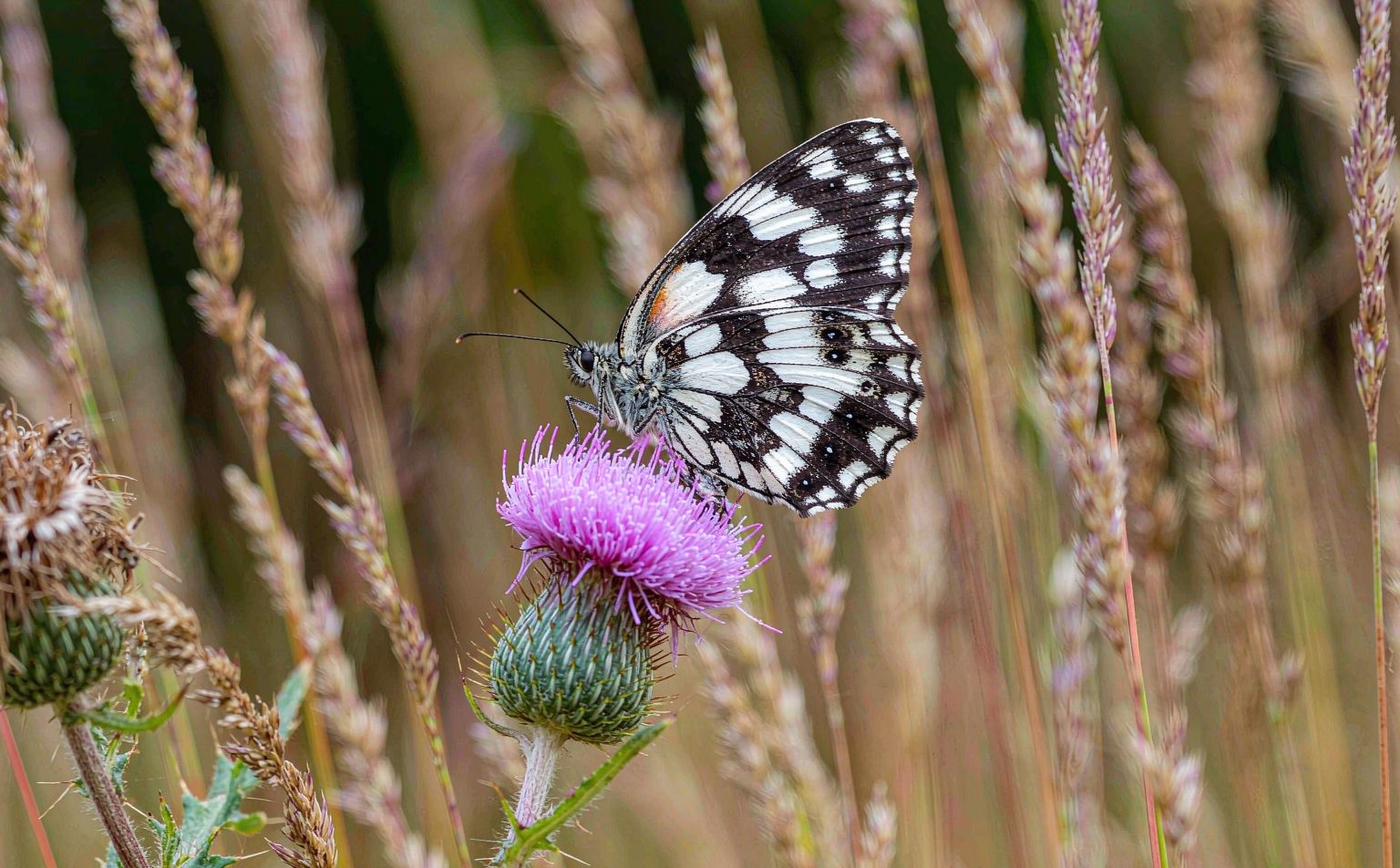
Melanargia galathea | Marbled White
Introduction
The Marbled White (Melanargia galathea) is a striking black-and-white butterfly of chalk and limestone grassland, its chequered wings giving it a marble-like pattern quite unlike any other British or northwestern European butterfly. It gathers in numbers on flower-rich downland in mid-summer, fluttering low over the grass with a characteristically lazy, wandering flight. Though it looks like a butterfly of open meadow, it is a member of the browns, not the whites.
Taxonomy
The Marbled White is a satyrine, a member of the family Nymphalidae and the subfamily Satyrinae, related to the [Meadow Brown](https://www.gloencyc.com/peacock-butterfly-aglais-io/) and the grassland browns despite its black-and-white look. It is the only species of its genus in Europe and is confined to the south and west of the continent and into temperate Asia. Its markings set it apart from the true whites such as the [Small White](https://www.gloencyc.com/small-white-butterfly-pieris-rapae/).
Physical Characteristics
Adults have a wingspan of 46 to 56 millimetres. The wings are white above, boldly marked with black veins, blotches and a black margin bearing white spots, a marbled pattern that gives the species its name; the undersides are a softer grey and brown checker with small eyespots. Females are slightly larger and plainer than males, which show more extensive black.
The body is slim and dark-furred, the antennae tipped with slender clubs. The caterpillar is a pale green larva with a darker line and a forked tail, hidden among grass blades. The chrysalis is green at first, later turning brown, and lies in a loose silk shelter at the base of a grass tuft.
Habitat
The Marbled White is a butterfly of calcareous grassland: chalk and limestone downland, meadows, verges and sunny hillsides with tall, flower-rich turf. It needs the fine-leaved grasses its caterpillars eat and a sequence of blooms for the adults, so it disappears from improved, fertilised or over-grazed land. It is a characteristic species of well-managed grassland reserves and roadside banks.
Diet
Adults take nectar from a variety of meadow flowers, showing a strong liking for thistles, knapweeds, scabious, clover and hawkbits, and they bask with wings half open between feeds. The caterpillars feed on grasses such as sheep’s fescue, red fescue and meadow grasses, eating mainly at night and resting low in the sward by day. The link to fine-leaved grasses explains the butterfly’s strict attachment to unimproved turf.
Reproduction
Females lay eggs loosely among grass, often simply dropping them in flight over suitable sward rather than placing each one. The tiny caterpillars hatch and begin feeding, growing slowly before overwintering as small larvae and completing their growth the next year. There is a single generation annually, the adults flying from late June to August, with the chrysalis forming at the base of a grass tuft in early summer.
Conservation
The Marbled White remains common on remaining chalk and limestone grassland but has lost ground where such habitat has been ploughed or enriched, and it is a valued indicator of good meadow quality. It responds well to light grazing or timed mowing that keeps tussocky, flower-rich sward, and to the protection of roadside and reserve grassland. Because it forms showy aggregations, it is a useful flagship for downland conservation.
Fun Facts
- Its black-and-white wings are unique among north European butterflies, earning the “marbled” name.
- Despite the look, it is a brown butterfly, not a true white, by family.
- It flies with a lazy, wandering flutter low over chalk grassland.
- The caterpillar overwinters tiny and finishes growing the next spring.
- Males gather where the turf is richest, making the species easy to count for surveys.