 By st20113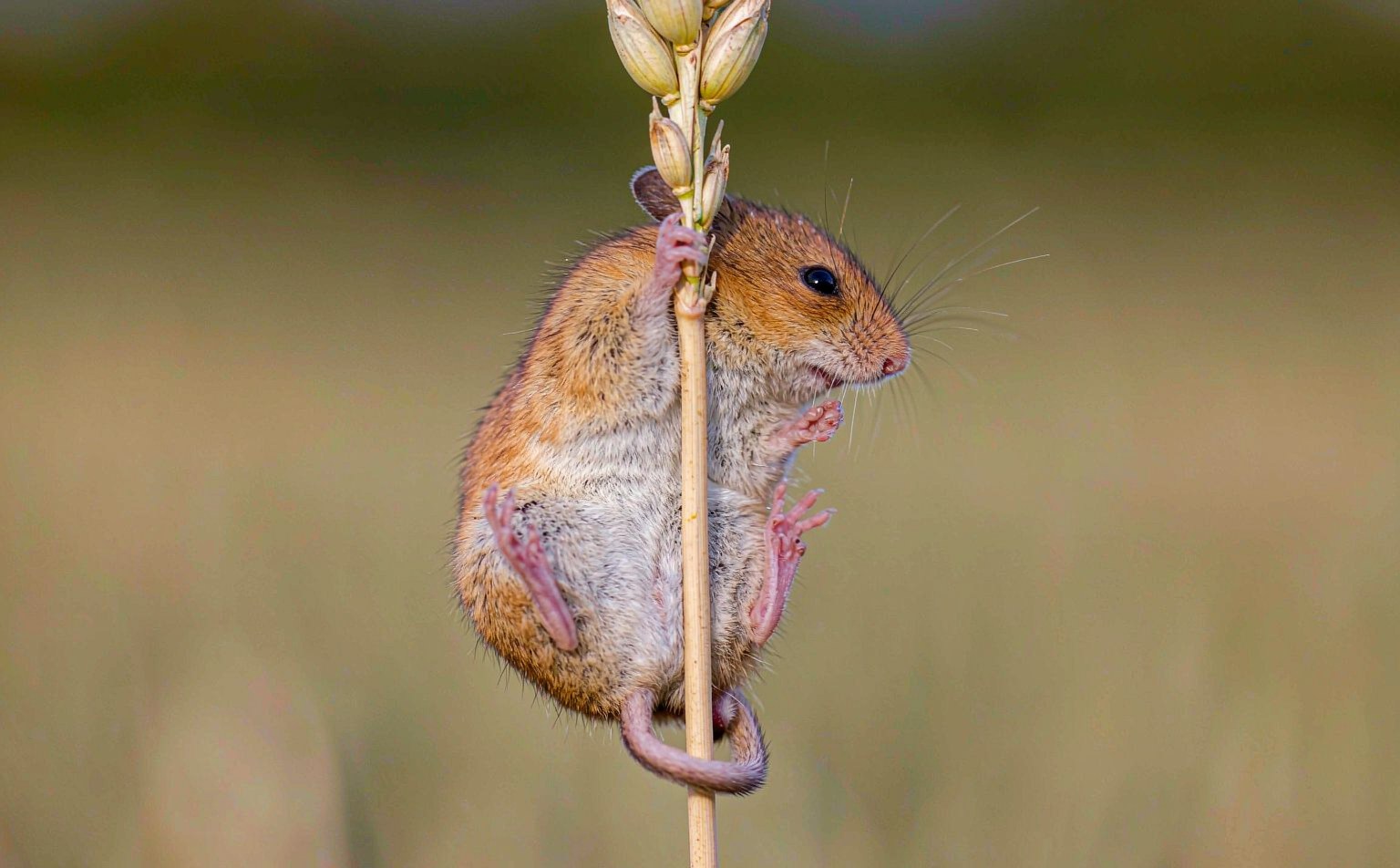
Micromys minutus | Harvest Mouse
Introduction
The Harvest Mouse (Micromys minutus) is the smallest rodent in Europe, a tiny golden-brown mouse that spends its life among grasses and reeds, building the only round, woven nest of any British or European mouse. Light enough to run along a single stalk, it is a specialist of tall grassland and cereal fields, and its decline with modern farming has made it a symbol of healthy, flower-rich meadow.
Taxonomy
The Harvest Mouse is the only member of the genus Micromys, a tiny rodent in the family Muridae, and is found across temperate Europe and into Asia. It is distinct from the larger [Wood Mouse](https://www.gloencyc.com/apodemus-sylvaticus-wood-mouse/) and the [Edible Dormouse](https://www.gloencyc.com/glis-glis-edible-dormouse/), both of which share its grassland and woodland-edge homes but build different nests. Its prehensile tail sets it apart from nearly all other European mice.
Physical Characteristics
An adult weighs just 4 to 11 grams and has a head and body of 55 to 75 millimetres, with a tail of similar length that is bare underneath and can grip like a fifth limb. The fur is warm ginger to golden-brown above and pale creamy below, the eyes and ears large for its size. The claws are small and fine, suited to clinging to stems rather than digging.
The skull is delicate, with small teeth and upper molars that simplify with wear, a feature used to age individuals in studies. The grasping tail is the key field mark: no other European mouse can hang by it from a reed. The coat is soft and dense, giving the animal a rounded, plush look.
Habitat
The Harvest Mouse lives in tall, undisturbed grassland: meadows, roadside verges, reed beds, hedgerows, cereal crops and riverside rushes. It needs stems sturdy enough to support its tiny weight and dense enough to hide its nests, so it disappears from short, heavily grazed or regularly mown land. It is most often found where grasses and flowers grow in a continuous, tussocky sward.
Diet
Harvest mice feed mainly on seeds, especially those of grasses and cereals, together with flower parts, green shoots, fruits and the occasional small insect. They eat by holding food in the forepaws and nibbling, often while suspended from a stem by the tail. In autumn they take the ripening grain of standing crops, then move to reed seeds and hedge fruits as the season turns.
Reproduction
The breeding season runs from late spring to autumn, with females building a neat spherical nest of woven grass blades, about 7 to 10 centimetres across, wedged among stems a few centimetres above the ground. Three to eight young are born blind and naked after a gestation of around seventeen to eighteen days, and they are weaned within two to three weeks. Several broods may be raised in a good year, and the last litters overwinter in grass nests or burrows.
Conservation
The Harvest Mouse has declined across much of its range as intensive agriculture removed tall, permanent grassland and hedge bottoms, and it is a species of conservation interest in several countries. It benefits strongly from field margins, buffer strips and unmanaged verges that keep tall grass through the season. Because it is hard to survey, its true numbers are uncertain, and habitat creation remains the main tool for supporting it.
Fun Facts
- It is the only European mouse that builds a closed, ball-shaped nest of woven grass.
- Its tail can grip stems like a hand, letting it run along the tops of wheat.
- An adult is light enough to balance on a single grass stalk.
- The species is the smallest rodent in Europe, weighing less than a penny coin.
- Nests are placed just above the ground so rising water rarely floods them.