 By st20113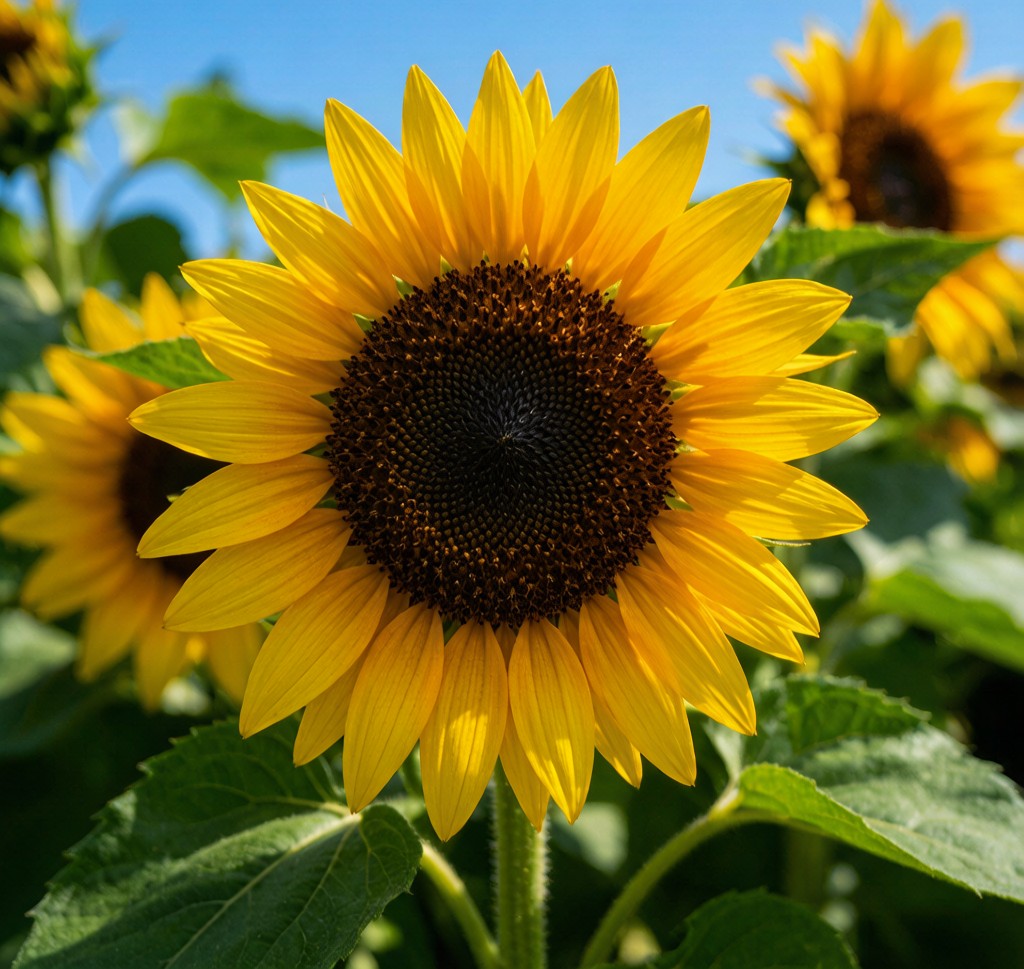
The common sunflower (Helianthus annuus) is one of the most important oilseed crops in the world and one of the most cheerful and recognisable plants in any garden or field — a tall, bright-yellow giant of the Americas that has been cultivated by human societies for over 4,500 years and now covers millions of hectares of agricultural land across every continent except Antarctica. The sunflowers’ large flower heads — technically known as capitula, consisting of hundreds of individual florets arranged in two interlocking spirals following the mathematical Fibonacci sequence — track the sun across the sky from east to west each day, a phenomenon known as heliotropism, until the florets in the centre of the head mature and the head locks into a fixed eastward orientation to maximise warmth for visiting pollinators. Native to North America, where it grew wild across the Great Plains from Canada to Mexico, the sunflower was domesticated by indigenous peoples over 4,000 years ago, transformed into a high-yielding global crop during the 20th century, and now ranks among the top five oilseed crops worldwide with an annual production exceeding 50 million tonnes.
## Physical Characteristics
The sunflower is a robust, hairy annual herb that grows rapidly to heights of 1 to 5 metres, with a rough, hairy stem that is typically unbranched in cultivated varieties but may produce multiple branches in wild populations. The leaves are large, rough, and heart-shaped or triangular, arranged alternately along the stem and held on long, winged stalks. The root system is a deep taproot that can extend 1.5 to 3 metres into the soil, allowing the plant to access water and nutrients unavailable to more shallow-rooted crops. The flower head is the most distinctive feature: a large, daisy-like inflorescence ranging from 7 to 30 centimetres in diameter, with bright yellow ray florets — which are sterile and serve only to attract pollinators — arranged around a dark central disc of hundreds of individual tubular disc florets, each of which will develop into a single sunflower seed. The seeds are large, oval, and black with white or grey stripes, depending on the variety, and contain a high proportion of edible oil — typically 38 to 50 percent by weight — that is highly valued for cooking and industrial applications.
## Habitat and Distribution
The wild ancestor of the cultivated sunflower, Helianthus annuus var. texanus, is native to the arid and semi-arid grasslands of the Great Plains and western United States, where it grows in disturbed soils along roadsides, field margins, and overgrazed pastures. The cultivated sunflower has been bred for agricultural use and is now grown worldwide as a summer annual crop in temperate, subtropical, and tropical regions between approximately 50 degrees north and south latitude. Major production areas include Russia, Ukraine, Argentina, the United States, China, the European Union, and South Africa. Sunflowers are grown as a component of crop rotation systems because their deep taproot can break up compacted soil layers and access nutrients from deeper soil horizons, and their ability to thrive in relatively low-input conditions makes them suitable for use in regions where irrigation and fertiliser availability are limited.
## Economic and Ecological Importance
Sunflower oil is one of the most important edible oils globally, valued for its light flavour, high smoke point, and high content of vitamin E and unsaturated fatty acids including linoleic and oleic acid. The decorticated meal remaining after oil extraction is a high-protein animal feed supplement. Sunflower seeds are also consumed directly as a snack food and birdseed. The plant is of considerable ecological importance beyond its agricultural value: the large flower heads attract and support populations of bees, butterflies, and other insect pollinators during the summer months, and the seeds provide a critical food source for a wide variety of bird species including finches, sparrows, and quail, as well as for small mammals including mice and squirrels. Sunflowers have also been studied for their potential role in phytoremediation — the use of plants to absorb and concentrate toxic metals and radionuclides from contaminated soils — following observations that some sunflower cultivars can accumulate significant quantities of lead, arsenic, and uranium from polluted soils.
## Heliotropism
One of the most remarkable features of the sunflower is the heliotropic behaviour of the immature flower head: during the day, the developing bud tracks the sun from east to west, and at night it reorientates eastward in anticipation of the next sunrise. This movement is driven by differential growth of the stem’s motor cells on the eastern and western sides, controlled by the plant’s circadian clock and light-signalling mechanisms. Research has shown that heliotropism in the bud provides several advantages: it increases the temperature of the flower head, which accelerates pollen tube growth and seed development; it maximises photon capture for photosynthesis in the chloroplast-rich ray florets; and it may help attract more pollinating insects, which are more likely to visit warmer flower heads. Once the florets begin to mature and pollen is shed, the head ceases its daily tracking movement and locks into a permanent eastward orientation.