 By Iris
Tarsius tarsier | Spectral Tarsier
Species Profile · Tarsiidae
Spectral Tarsier
A primate the size of a rat, with eyes as large as its brain.
Vulnerable
Body
Tail
Weight
Head turn
Leap
Rating
A hundred grams of grip
Two eyes and no night left
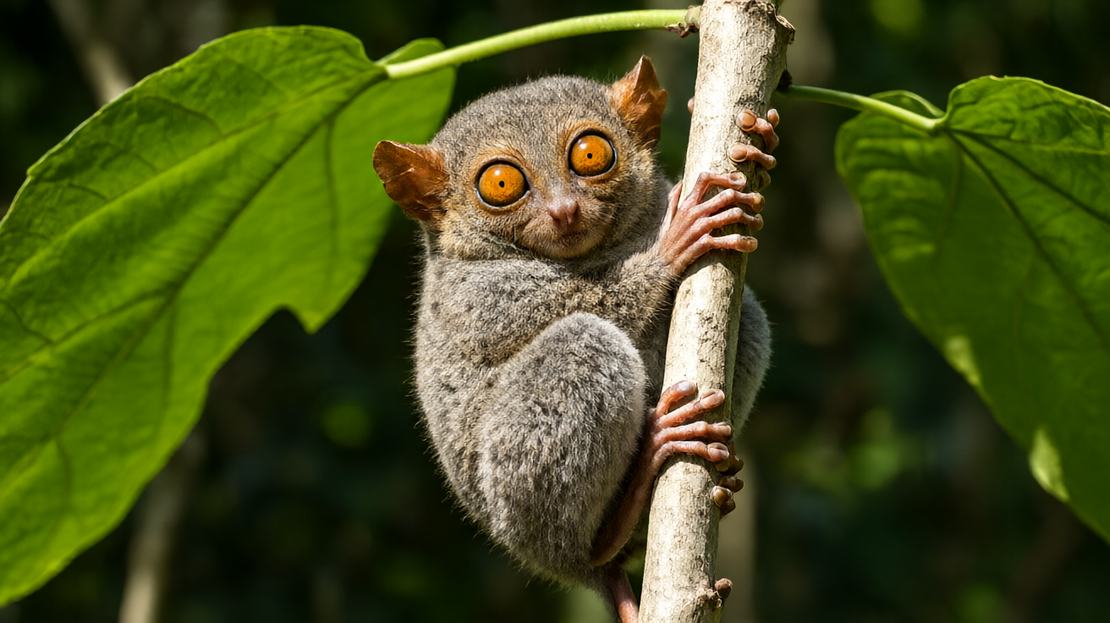
Two orange eyes open in the dark of a Sulawesi fig tree. They belong to a primate no bigger than a rat. Spectral tarsiers spend the night hunting insects among thin saplings. By day they sit in dense cover, often on the very same perch. Bodies run 10 to 15 cm, and the tail adds another 20 cm.
Weight stays near 100 to 140 g. A tarsier weighs less than a bar of soap. Those eyes are huge. Each one is about as large as the brain behind it. Head turning goes far beyond the human range.
An animal can look almost straight backward without shifting its body at all. Nothing else in the forest looks back like that. Sight guides the hunt, since hearing matters less at such close range. Grip matters just as much, because a missed branch ends the night badly.
Family tree
Tarsiidae, the tarsiers
Tarsiers form a family of their own, and the group has no close living relatives. Monkeys, apes and people share an older branch with them, so tarsiers sit near the base of that line. Unlike the Ring-tailed Lemur, a tarsier keeps a dry nose and leans on its eyes. Lemurs keep a wet nose and a keen sense of smell.
Tarsiers rely on dry noses and very large eyes instead. The genus once held a single wide-ranging species. Work since the 1990s raised that count on Sulawesi alone, and more names may follow. This species keeps the name tarsier, and it lives in the north of the island.
Its nearest kin include the spectral tarsiers of neighbouring islands. Fossils from Asia and Europe show that the family once spread far beyond Sulawesi. The line is old, and it has changed so little in shape that early fossils look much like living animals. Genetic work confirms the split from other primates, yet it leaves the species limits unclear.
A family with no close kin
How to tell one
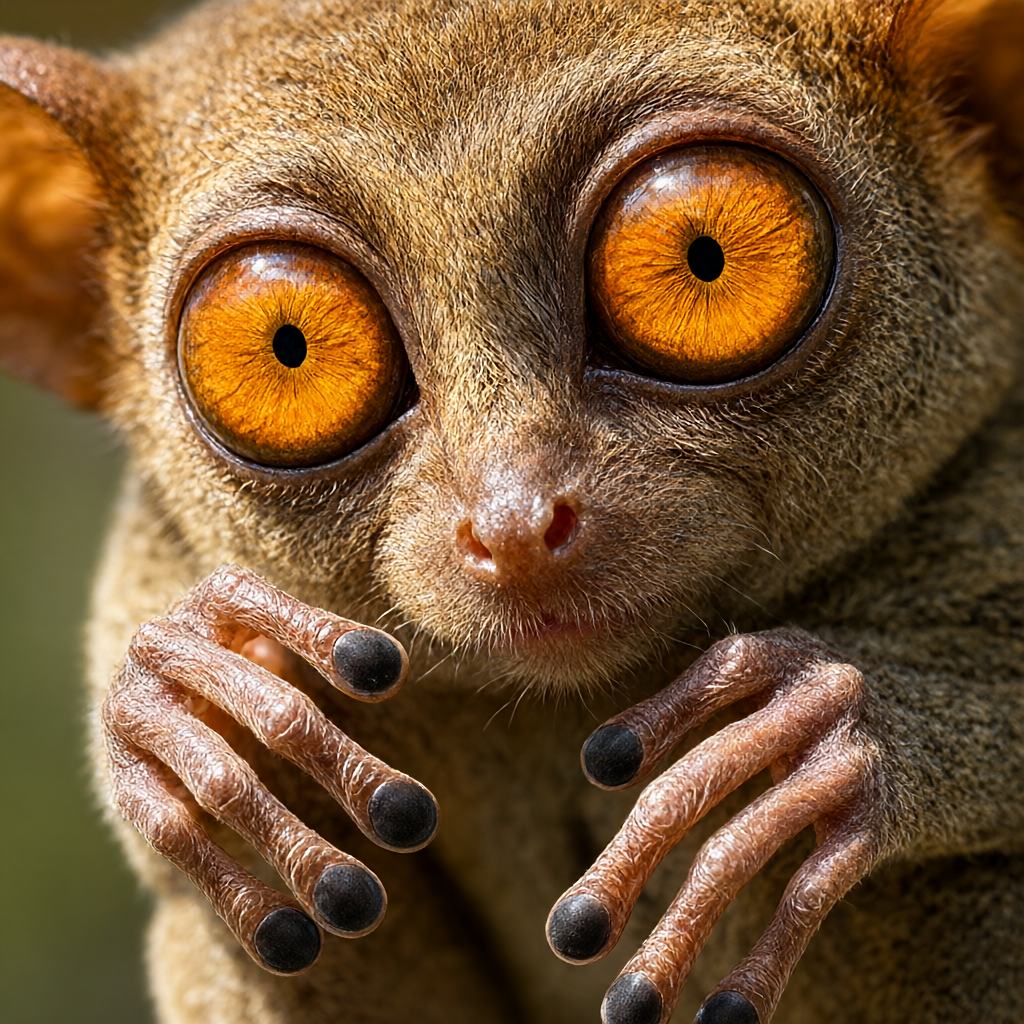
Fur is soft and dense. Limbs are long for the size of the body, and the hind legs carry most of the jumping power. Fingers end in round pads, which grip bark without slipping. The second and third toes carry grooming claws rather than flat nails. A tarsier can turn its head about 180 degrees in either direction.
Eyes face forward, and they sit in bony sockets that limit movement, so the neck does the work. No reflective layer sits behind the eye, which is unusual for a night animal. Instead the eye gathers light through a wide pupil. Each eye holds a small region of sharp focus, and that patch helps the animal in very dim light. Ears are thin and mobile, and they twitch toward small sounds.
The tail is longer than the body, and it bends like a wire. Females carry two nipples low on the belly. Males weigh a little more than females in most groups.
1
2
3
Eyes bigger than the stomach
Where it lives
Lowland forest on Sulawesi holds the species, from the coast up to about 1,100 m. Dense saplings matter more than big trees, since the animals leap between thin stems. Fig trees draw them, because insects gather at the fruit. Bamboo thickets also hold animals.
Secondary forest can suit them, although very open ground does not. Rain falls through most of the year here, and the nights stay warm. Mangrove edges sometimes carry tarsiers, since insects swarm above the mud. Villages lose them quickly once the undergrowth is cleared.
Gardens hold a few animals. Forest loss breaks the population into small pieces, and each piece loses variety. Roads cut the remaining cover, and tarsiers refuse to cross open ground. Altitude and rainfall shape the range more than soil does, since the animals need warm nights all year.
Saplings in lowland forest
What it eats
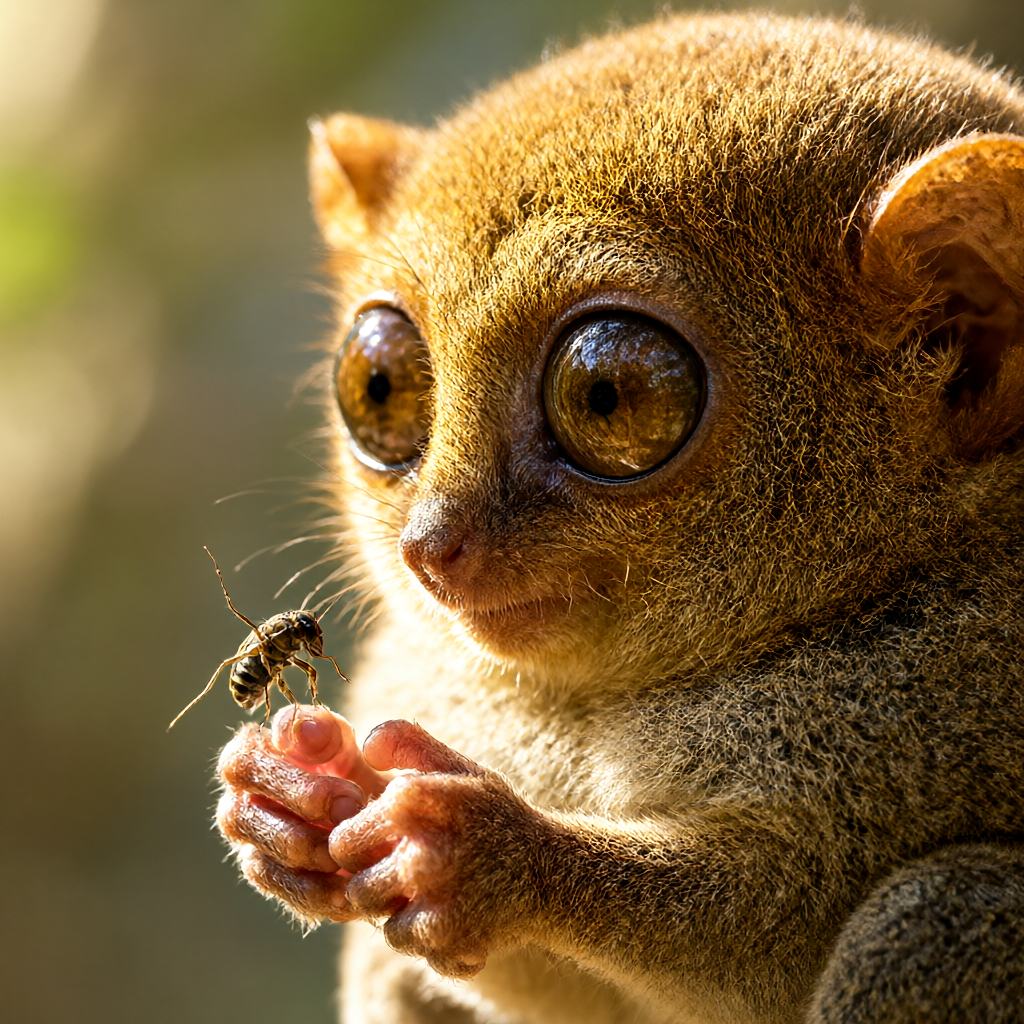
Insects form almost the whole diet. Moths and ants get taken too. Larger prey appears now and then, including small lizards and frogs. A tarsier catches food with both hands, then bites the head first.
That habit stops a struggling insect from biting back. Hunting takes place in short bursts, with long pauses between them. Most strikes happen within a few metres of the ground. Prey gets swallowed whole, and hard parts come back up later as pellets.
A mother shares prey with her infant, which helps the young learn what to catch. Water comes from dew and from the body of the prey, so the animals seldom drink. Food shortages hit small primates hard, since a body this size holds almost no fat to burn. Insect numbers follow the rains, and the animals breed when food peaks.
Insects, head first
The breeding cycle
Nights begin with a duet of calls, and pairs answer each other for several minutes. Calls mark boundaries. Males mark twigs with scent, and they also rub their chests on bark. Family groups hold a small patch, and they sleep together in a tangle of stems.
An animal wakes at dusk and grooms before it hunts. Leaps cover 1 to 3 m, and a tarsier rarely moves along a branch on foot. Pairs stay together through the year, although mating has no fixed season. Pregnancy lasts about six months, which is long for an animal of this size.
One infant is born, and it clings to the mother’s belly for the first weeks. A mother parks her infant on a branch while she hunts, and she returns to feed it. Young animals start catching insects at about a month old. Females leave their birth group, while males often stay near it.
Vulnerable, and pet traded
Conservation
The IUCN lists the species as Vulnerable, and the decline continues. Forest loss drives that fall, since lowland Sulawesi is being cleared fast. Agriculture, mining and housing all take the same ground. Hunting adds pressure in some districts, because people keep tarsiers as pets.
A pet tarsier usually dies young, since the animal cannot be fed by hand for long. Protected areas cover part of the range. Numbers fall outside them, and no count covers the whole island. Rehabilitation centres take confiscated animals, yet release rarely works.
Survival depends on connected forest, since cut-off groups lose their gene pool within a few short generations. Local taboos protect tarsiers in a few villages, and those populations hold steady. Laws against capture exist, but enforcement stays weak in remote districts. Long-term work now focuses on forest strips between reserves, and some corridors have been planted.
Side by side
How It Compares
| Trait | Spectral Tarsier | Ring-tailed Lemur |
|---|---|---|
| Body | 10 to 15 cm, plus a 20 cm tail | about 40 cm, plus a 60 cm tail |
| Weight | 100 to 140 g | 2.2 to 3.5 kg |
| Eyes | each as large as the brain | smaller, with a wet nose and keen smell |
| Active | night | day |
| Home | lowland forest on Sulawesi | dry forest in southern Madagascar |
| Rating | Vulnerable | Endangered |
Common misreadings
What People Get Wrong
- Many people take the tarsier for a small lemur, yet the two families split very early.
- A popular claim says the animal has a wet nose, although its nose stays dry all year.
- Some guides say the eyes move in the socket, yet the neck does all the turning.
Going further
Sources and Further Reading
Quick hits
Five things to remember
- A tarsier weighs less than a bar of soap.
- Each eye is about as large as the brain.
- The head turns almost 180 degrees.
- No reflective layer sits behind the eye.
- Infants get parked on a branch while the mother hunts.