 By st20113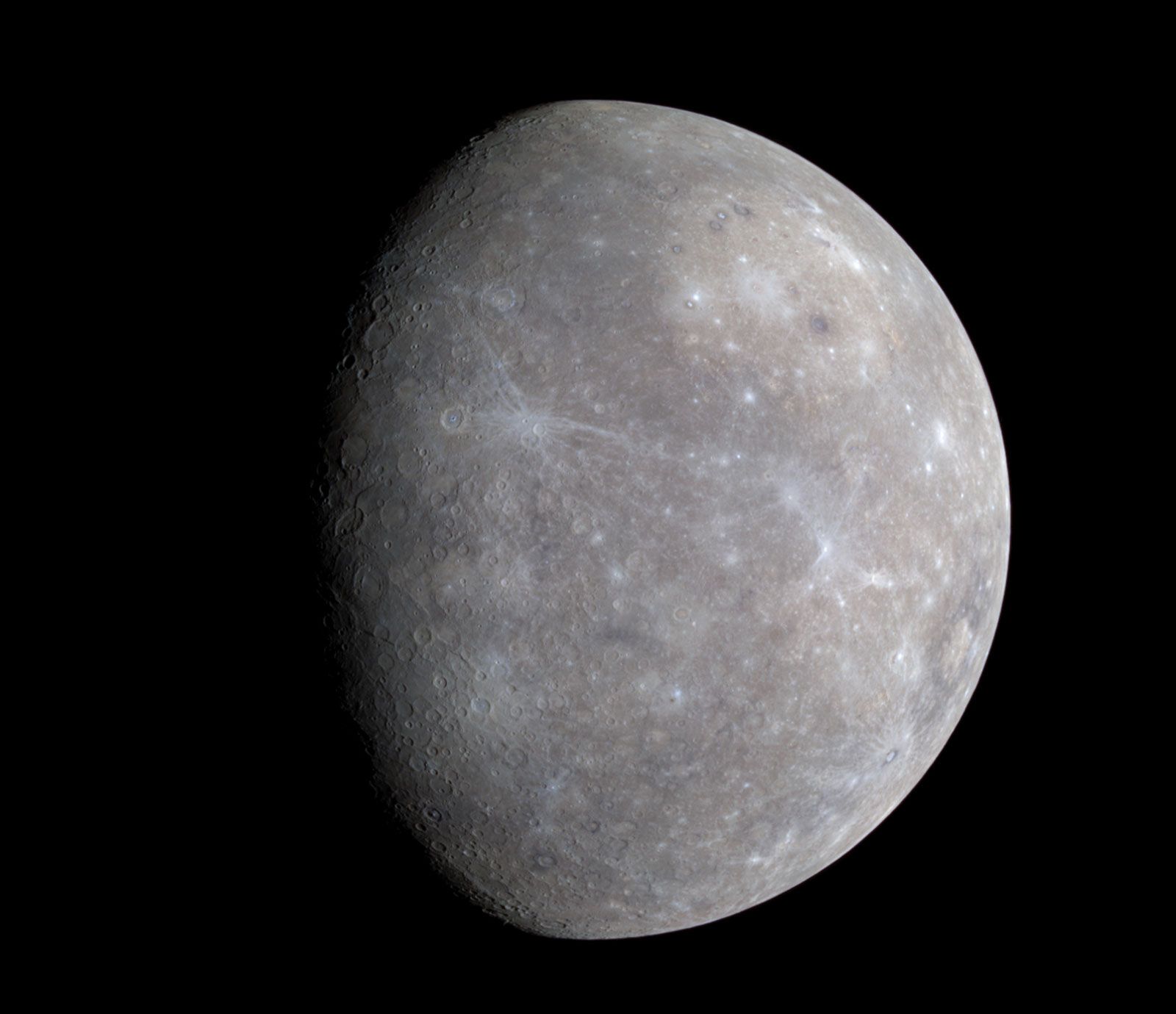
Mercury is the innermost planet of the Solar System, orbiting closer to the Sun than any other world. At an average distance of about 58 million kilometers, it races around the Sun once every 88 Earth days, the shortest year of any planet. Despite being nearest the Sun, Mercury is not the hottest planet; that title belongs to Venus, because Mercury lacks the thick atmosphere needed to trap heat. Small and gray, scarred by craters, Mercury looks much like the Moon and is the smallest planet, only slightly larger than our own Moon.
What makes Mercury extraordinary is its interior. Unlike the other rocky planets, Mercury has a disproportionately huge iron core that occupies about 75 percent of the planet’s radius, leaving only a thin shell of rock above it. This iron-rich makeup gives Mercury the highest uncompressed density of any planet, a sign that it may have lost much of its original outer layers early in its history, perhaps through a giant collision or the fierce early heat of the young Sun. The large molten core also generates a magnetic field, weak but real, a surprise for such a small body.
Mercury’s surface tells a story of fire and ice. With almost no atmosphere to hold or spread heat, the planet swings between extremes unmatched elsewhere: daytime temperatures at the equator can climb to about 430 degrees Celsius, hot enough to melt lead, while on the night side they plunge to around minus 180 degrees Celsius. Yet in a handful of deep polar craters that never see sunlight, temperatures stay cold enough to trap water ice, delivered by comets and asteroids, a startling reservoir on the planet closest to the Sun. The surface itself is a record of billions of years of meteorite impacts, crossed by great cliffs formed as the planet cooled and shrank.
Mercury has a strange relationship with the Sun’s spin. Instead of keeping one face turned sunward, as was once thought, it rotates three times for every two orbits, a pattern called a 3:2 spin-orbit resonance. As a result, a single solar day on Mercury lasts about 176 Earth days, twice its year, and the Sun appears to rise, pause, reverse slightly, and then continue across the sky. This curious motion arises from the strong tidal pull of the Sun combined with the planet’s elliptical orbit.
For centuries Mercury was known only as a point of light, studied briefly by the Mariner 10 spacecraft in the 1970s, which mapped less than half the surface. The modern picture was built by the MESSENGER mission, which orbited Mercury from 2011 to 2015, charting the whole globe, confirming the polar ice, measuring the lopsided magnetic field, and revealing evidence of past volcanic flows. Later missions and continuing study show Mercury as a survivor from the Solar System’s violent youth, a dense iron world that preserves clues to how the innermost planets formed. Compared with the blue, living Earth, Mercury is a stark reminder of the range of worlds that orbit the same star, from barren, sun-scorched rock to oceans and life.