 By st20113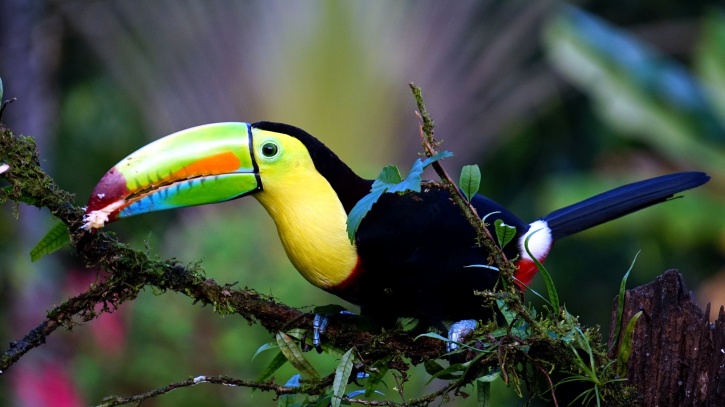
Toucans (family Ramphastidae) are a family of neotropical birds comprising approximately 42 species across five genera, best known for their extraordinarily large, brightly colored bills. Native to the tropical forests of Central and South America, toucans are among the most distinctive and recognizable birds in the world.
Physical Characteristics
Toucans range in size from 30 to 65 centimeters (12 to 26 inches) in length. Their most remarkable feature is the oversized bill, which in some species such as the toco toucan (Ramphastos toco) can measure up to 20 centimeters long—nearly a third of the bird’s total body length.
The bill is lightweight yet strong, constructed of a honeycomb of keratin supported by bony trabeculae. Its vibrant coloration—typically bold combinations of yellow, orange, red, green, blue, and black—serves as a visual display for species recognition and mate attraction. Despite its size, the bill is not heavy enough to impede flight significantly.
Toucans have compact bodies, short necks, and relatively short wings suited for forest habitats. Their feet are zygodactyl (two toes facing forward, two backward), an adaptation for gripping branches. Their tongues are long, narrow, and bristle-fringed.
Species Diversity
The most well-known species include the toco toucan (Ramphastos toco), the largest toucan species; the channel-billed toucan (Ramphastos vitellinus); the emerald toucanet (Aulacorhynchus prasinus); and the collared aracari (Pteroglossus torquatus). Each species displays unique bill patterns and color combinations.
Habitat and Distribution
Toucans inhabit lowland and montane tropical and subtropical forests, from southern Mexico through Central America into South America as far as northern Argentina. They are primarily forest-dwelling birds, found in the canopy and sub-canopy layers of dense rainforest, as well as in secondary forest and forest edges.
Diet and Ecological Role
Toucans are primarily frugivorous, consuming a wide variety of fruits including figs, berries, and other forest fruits. They play a crucial role in seed dispersal, swallowing fruits whole and depositing seeds throughout the forest as they fly. In addition to fruit, toucans eat insects, small reptiles, amphibians, and occasionally eggs of other birds.
Behavior and Reproduction
Toucans nest in tree cavities, often using old woodpecker holes or natural hollows. Clutches typically consist of 2 to 4 white eggs, incubated by both parents for approximately 16 to 20 days. Toucans are known to roost socially, with multiple birds fitting into a single cavity by folding their bills and tails.
Conservation
Most toucan species are currently listed as Least Concern, though some populations face pressure from habitat loss and hunting. Toucans are popular in the pet trade in some regions, and some species are hunted for their colorful feathers.