 By st20113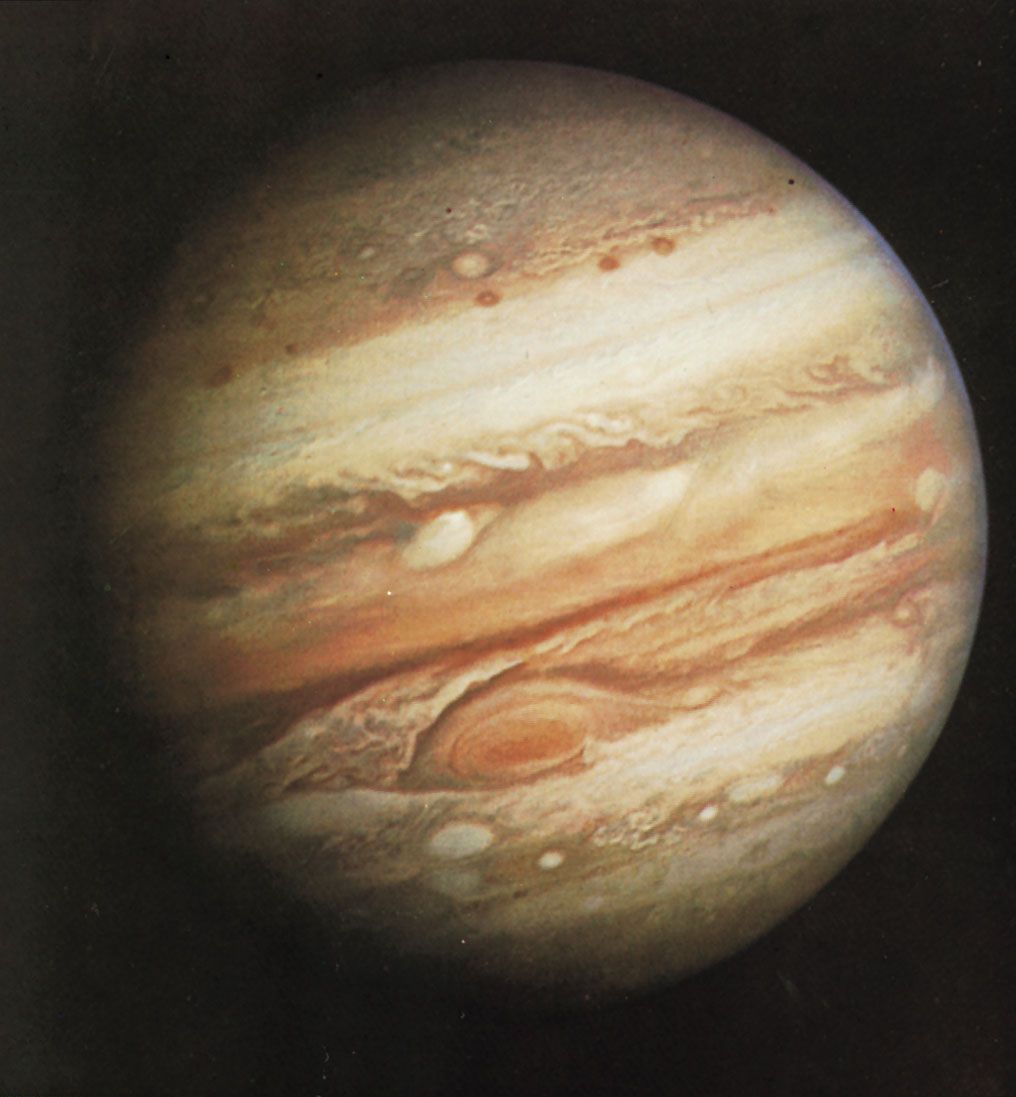
Jupiter is the largest planet in the Solar System, a giant more massive than all the other planets combined. It is the fifth planet from the Sun, orbiting at an average distance of about 778 million kilometers and completing one circuit every 11.9 Earth years, while spinning faster than any other planet, once every 9.9 hours. This rapid rotation and its fluid makeup give Jupiter a slightly squashed, banded appearance. Along with Saturn, it is a gas giant, a world without a solid surface, made mostly of the lightest elements in the universe.
Jupiter’s bulk is composed overwhelmingly of hydrogen, with most of the rest helium and only traces of heavier substances. Beneath the colorful cloud tops, the gas grows ever denser and hotter with depth. In the deep interior, crushed by pressures millions of times that of Earth’s atmosphere, hydrogen takes on a strange metallic form: liquid metallic hydrogen, in which the gas conducts electricity like a metal. This vast conducting ocean, together with the planet’s fast spin, generates the most powerful magnetic field of any planet, creating an enormous Earth-spanning magnetosphere that traps energetic particles and produces intense radiation belts.
The visible face of Jupiter is a tapestry of bands and zones, light and dark stripes of cloud running parallel to the equator, driven by jet streams and the planet’s rotation. The most famous feature is the Great Red Spot, a storm wider than the Earth that has raged for at least three centuries, a giant whirl of crimson clouds circling in the southern hemisphere. Smaller storms and swirls constantly appear and fade, and the whole atmosphere is a restless, turbulent weather system on a scale unknown on our own planet.
Jupiter is encircled by a faint system of rings, discovered by spacecraft, but its true glory lies in its family of moons: more than ninety are known, and four of them are so large and bright that they were seen by Galileo in 1610, earning the name Galilean moons. Io is the most volcanically active body in the Solar System, its surface constantly reshaped by tides raised by Jupiter’s gravity. Europa is wrapped in a shell of ice over a hidden ocean that may hold more water than all of Earth’s seas, making it a prime target in the search for life. Ganymede is the largest moon in the Solar System, bigger than the planet Mercury, and Callisto is a heavily cratered, ancient world. Each of these moons is a world in its own right, and together they form a miniature planetary system around Jupiter.
The study of Jupiter has been transformed by robotic explorers, from the Pioneers and Voyagers to the Galileo orbiter and the Juno spacecraft currently mapping its gravity and magnetic fields. These missions have revealed the depth of the Great Red Spot, the structure of the metallic hydrogen interior, and the surprising activity of the moons. Jupiter’s enormous mass has also shaped the history of the Solar System, its gravity deflecting comets and asteroids that might otherwise have struck the inner planets. For all these reasons Jupiter is not merely the king of planets but a key to understanding how giant worlds form around other stars and how the architecture of our own cosmic neighborhood came to be.