 By st20113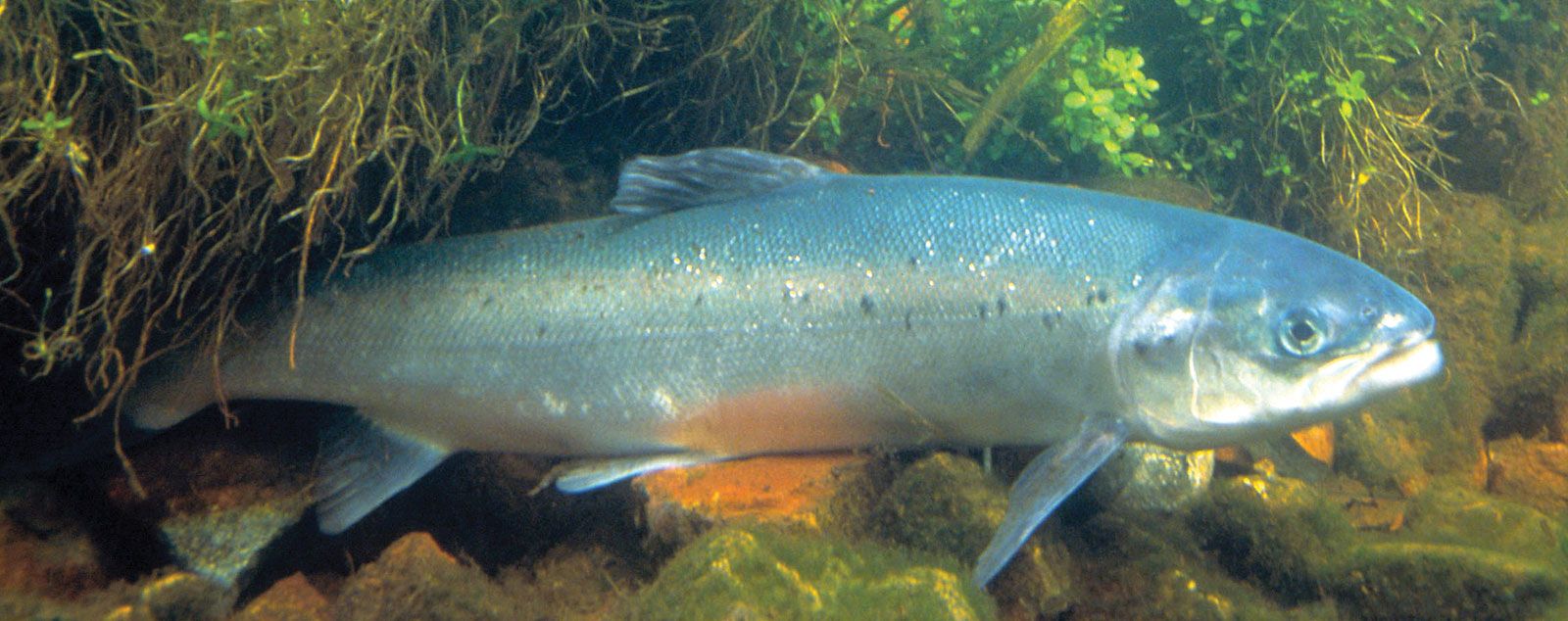
The Atlantic salmon is a large, migratory fish known to science as Salmo salar. It belongs to the same family as trout and char and is prized by anglers and cooks alike for its silvery beauty and rich, oily flesh. Unlike its Pacific relatives, the Atlantic salmon can spawn more than once, returning to the sea after breeding and sometimes repeating its epic journey several times in a single lifetime. It is found across the North Atlantic, from rivers in North America and Greenland to those of Europe and as far south as Spain and Portugal.
The life of an Atlantic salmon is defined by movement between fresh and salt water, a pattern called being anadromous. The fish begins life in the gravel of a cool, oxygen-rich river, where the egg hatches into a tiny alevin that feeds on its yolk sac before emerging as a parr, a small fish marked with dark vertical bars. After one to several years the parr undergoes a remarkable transformation called smoltification: its body becomes silvery, its physiology changes to tolerate salt water, and it swims downstream to the ocean. There it may roam for one to three years, feeding and growing rapidly, before an instinct as precise as any compass draws it back to the very river of its birth.
This homing navigation is one of the wonders of the natural world. Salmon are thought to use the Earth’s magnetic field as a guide on the open ocean and then to recognize the unique chemical signature, or smell, of their natal stream as they approach the coast. Guided by these cues they leap up waterfalls and surge against currents to reach the gravel beds where they were born. There they spawn, the female digging a nest, or redd, and the male fertilizing the eggs, after which most adults weaken and many die, their bodies enriching the river with marine nutrients.
Ecologically, salmon are far more than a single species. By carrying nutrients from the ocean into inland rivers, they feed a wide community of predators and scavengers, from brown bears and eagles to otters, insects, and the trees whose roots draw on the enriched soil. The annual runs thus link the sea, the river, and the forest into a single connected web, a vivid example of how a migrating animal sustains an entire ecosystem. Their passage also depends on the clean, flowing water of healthy rivers, tying their fate to the broader water cycle that fills and refreshes those streams.
Today the wild Atlantic salmon faces serious pressure. Dams and culverts block migration routes, water pollution and warming rivers reduce survival, and overfishing has cut stocks in many regions. At the same time, salmon farming has expanded, raising fish in coastal pens to meet demand. While aquaculture supplies food, escaped farmed salmon can spread disease and compete with wild ones, and the concentrated waste can harm local waters. Managing the balance between farmed and wild populations, restoring river passages, and keeping waterways cool and clean have become central goals for those who hope to see the silver travellers return each year. The Atlantic salmon endures as both a cultural icon of the North Atlantic peoples and a living measure of the health of the rivers it has haunted for millions of years.
[…] marked with a pale lateral line and a distinctive chin barbel. Like other northern fish such as the Atlantic salmon, the cod is a cold-water species central to both ecology and […]
[…] covered in a mucus-rich skin rather than prominent scales. Like other migratory fish such as the Atlantic salmon, the European eel undertakes one of the animal kingdom’s most remarkable journeys between […]
Salmonidae, which also includes salmon, char, and grayling, and it is a close relative of the Atlantic salmon. It was first described by Carl Linnaeus in 1758. The species shows extraordinary variation, and
[…] that completes its cycle in streams. Among migratory fish it shares clean lowland rivers with the Atlantic Salmon, and its rearing streams overlap those used by the Brown Trout, both of which need the same clear, […]