 By st20113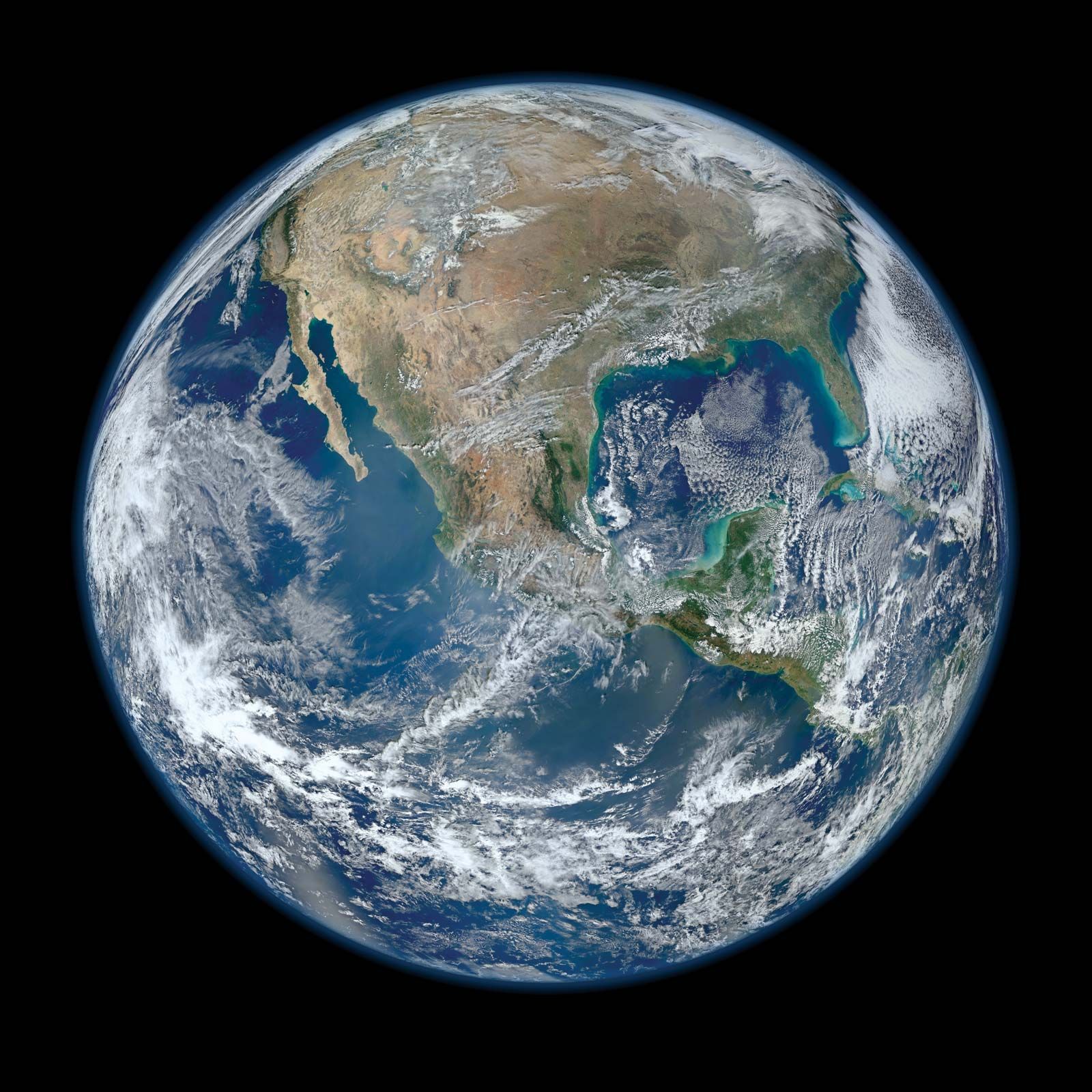
Earth is the third planet from the Sun and the only world known to support life. It is the largest of the four rocky, or terrestrial, planets and the fifth largest overall, with an equatorial diameter of about 12,742 kilometers. Sometimes called the Blue Planet for the oceans that cover some 71 percent of its surface, Earth occupies a special position in the habitable zone, the region around the Sun where temperatures allow liquid water to exist. Its orbit is nearly circular, carrying it around the Sun once every 365.25 days at an average distance of about 150 million kilometers.
Beneath its surface Earth is layered like an onion. The outermost shell is the crust, a thin, brittle layer of rock only about 5 to 70 kilometers thick that forms the ocean floors and the continents. Below lies the mantle, a thick region of hot, slowly flowing rock extending nearly 2,900 kilometers down, which moves by convection over geologic time. At the center sits the core, composed mostly of iron and nickel. The outer core is molten, and its churning motion generates Earth’s magnetic field, which shields the surface from harmful solar radiation. The inner core is a solid ball of metal kept solid by immense pressure despite temperatures comparable to the surface of the Sun.
Earth’s atmosphere is a thin blanket of gases, dominated by nitrogen and oxygen, that protects life and makes the climate moderate. Oxygen, produced over billions of years by photosynthetic organisms, is essential for animals to breathe, while carbon dioxide and water vapor trap enough heat to keep the planet warm. The interaction of this atmosphere with the oceans drives the water cycle, in which water evaporates, forms clouds, and returns as rain and snow, constantly renewing rivers, lakes, and groundwater. This cycling of water, together with the energy of sunlight, sustains the vast web of living things.
The surface of Earth is never still. The crust is broken into large plates that drift atop the mantle in a process called plate tectonics. Where plates pull apart, new crust forms at mid-ocean ridges; where they collide, mountains rise and earthquakes occur. This slow movement rearranges continents over millions of years and helps regulate the planet’s long-term climate by cycling carbon between rocks, oceans, and air. Volcanoes vent gases from the interior, linking the deep Earth to the atmosphere.
Earth’s climate is also shaped by its relationship with the Moon, whose gravity produces the ocean tides. The Moon is unusually large relative to its planet, and its steady gravitational pull has helped stabilize Earth’s axial tilt over billions of years, contributing to a relatively stable climate. Earth’s tilt of about 23.5 degrees, combined with its yearly journey around the Sun, produces the seasons: when the northern hemisphere leans toward the Sun it enjoys summer, while the southern hemisphere experiences winter, and the pattern reverses half a year later.
Life itself is a defining feature of Earth. Through the process of photosynthesis, plants and algae capture sunlight and build the food that supports nearly all ecosystems, releasing the oxygen animals depend on. From the deep oceans to the highest mountains, life has transformed the planet’s air, water, and rock. Earth is best understood not as a lone sphere of rock but as a linked system in which the solid planet, the living ecosystem, the oceans, and the atmosphere constantly exchange energy and matter, making it a single, self-regulating world unique in our experience.