 By st20113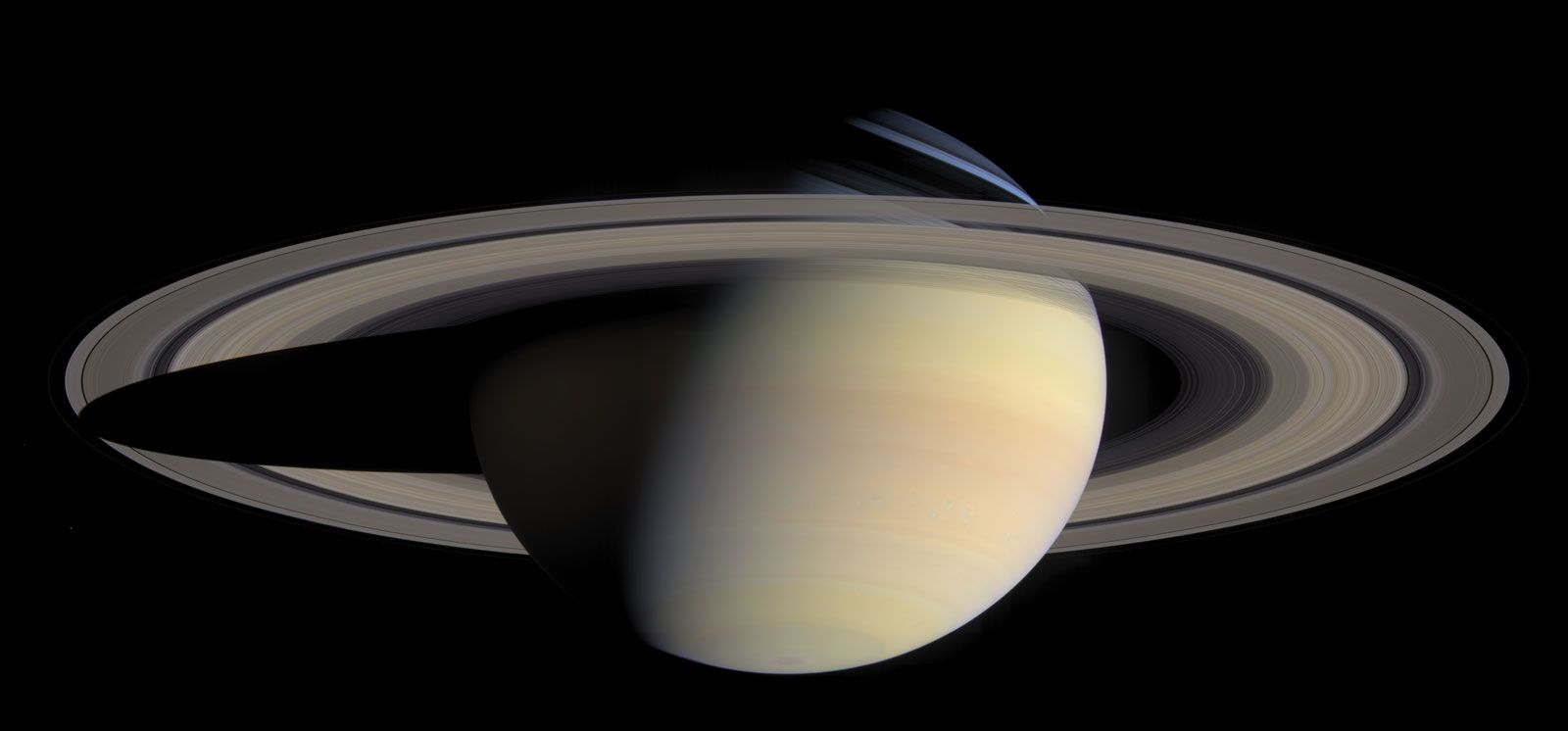
Saturn is the sixth planet from the Sun and the second largest planet in the Solar System, surpassed only by its neighbor Jupiter. A gas giant composed overwhelmingly of hydrogen and helium, Saturn lacks a solid surface on which a visitor could stand. It orbits the Sun at an average distance of about 1.4 billion kilometers, completing one revolution every 29.4 Earth years, while rotating rapidly on its axis once every 10.7 hours. That swift rotation, combined with the planet’s fluid interior, gives Saturn a markedly flattened shape, with an equatorial diameter of about 120,500 kilometers and a polar diameter some 10,000 kilometers smaller. Despite its great size, Saturn is the least dense of all the planets; its mean density is less than that of water, so in principle the entire planet would float in a sufficiently large ocean.
The feature for which Saturn is most celebrated is its spectacular system of rings. These rings are made chiefly of countless ice particles, ranging in size from microscopic grains to boulders several meters across, together with lesser amounts of rocky debris. The ring system spans roughly 280,000 kilometers from edge to edge yet is typically only about ten meters thick, an astonishingly thin sheet for such an enormous structure. The rings are divided into several major bands, conventionally labeled from A through G, separated by gaps such as the Cassini Division, a dark void produced by the gravitational influence of Saturn’s moons. Although the rings appear bright and massive from a distance, they are remarkably tenuous; gathered into a single body they would form a satellite no more than a few hundred kilometers across.
Saturn possesses an extraordinary family of moons, more than 140 confirmed at the latest count, and the study of these satellites has transformed planetary science. The largest is Titan, a world bigger than the planet Mercury and shrouded in a dense orange atmosphere of nitrogen and methane. Titan is unique among moons for hosting stable lakes and seas, though they are filled not with water but with liquid methane and ethane. The small icy moon Enceladus has proved equally remarkable: observations reveal plumes of water vapor and ice erupting from a subsurface ocean through cracks near its south pole, making it one of the most promising places to search for life beyond Earth. Other notable satellites include Mimas, whose great crater gives it a striking appearance, and Iapetus, which bears a dramatic two-tone coloring.
Human knowledge of Saturn advanced enormously through spacecraft missions that studied the outer planets. The Voyager flybys of the early 1980s first revealed intricate detail in the rings and storms in the atmosphere, but the greatest leap came with the Cassini spacecraft, which orbited Saturn from 2004 until 2017. Cassini released the Huygens probe, which descended onto the surface of Titan and returned the first images from the ground of another world’s moon. Over thirteen years the mission mapped the rings, discovered geysers on Enceladus, and studied seasonal changes in the atmosphere. When its fuel was nearly spent, Cassini was deliberately plunged into Saturn to avoid any chance of contaminating the potentially habitable moons.
Compared with Jupiter, Saturn is calmer in appearance, its cloud bands paler and its storms less frequent, though it too hosts a persistent polar hurricane and occasional great white spots. Like Jupiter, however, Saturn radiates more heat than it receives from the Earth-shared Sun, a sign that the planet is still slowly contracting and releasing the warmth of its formation. Both giants possess powerful magnetic fields and dozens of moons, yet Saturn’s ring system remains unmatched anywhere in the Solar System. Continued study of Saturn and its satellites informs our understanding of how planetary systems form and where conditions for life might arise.