 By st20113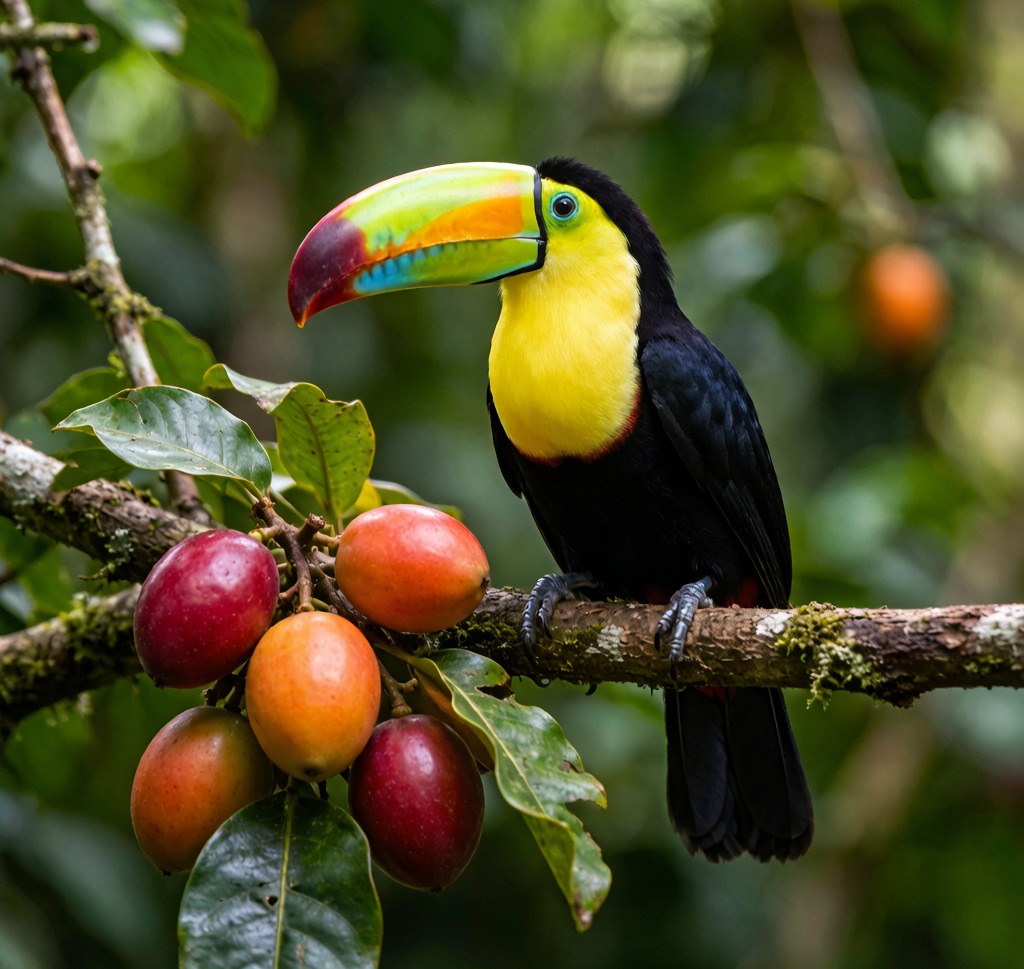
A Keel-billed Toucan (Ramphastos sulfuratus) perched on a branch in a Central American rainforest
Overview
The Keel-billed Toucan (Ramphastos sulfuratus) – also known as the Rainbow-billed Toucan – is one of the most spectacularly colorful birds in the Americas. Native to the tropical rainforests of Central and South America, this medium-sized toucan is instantly recognizable by its enormous, multi-colored bill that displays nearly every color of the rainbow. Despite its large size, the toucan’s bill is remarkably lightweight, constructed of a honeycomb of keratin over a bony framework.
Keel-billed Toucans measure approximately 42-55 centimeters in length, of which the bill accounts for about one-third. The body plumage is predominantly glossy black, with a bright yellow throat and breast, red feathers under the tail, and olive-green on the sides. The extraordinary bill – measuring 12-22 centimeters long – is primarily green with an orange tip, blue on the top ridge, red on the upper mandible, and yellow on the sides. This extraordinary structure is both a feeding tool and a social signaling device, used in threat displays, courtship rituals, and fruit plucking.
Habitat and Distribution
Keel-billed Toucans are found throughout the tropical lowland forests of southern Mexico, Central America, Colombia, and Venezuela. They inhabit the canopy and edges of evergreen and semi-deciduous rainforests, preferring areas with large, old-growth trees that provide suitable nesting cavities. They are generally non-migratory, with individuals maintaining year-round territories within their preferred forest habitat.
The toucan’s habitat requirements are closely linked to the availability of large, dead or dying trees with soft wood, which they excavate to create nest cavities. These trees are also important for the dozens of other species – including parrots, owls, and various mammals – that use old toucan nest holes. Forest fragmentation and the removal of large trees significantly impact toucan populations by reducing both nesting sites and the continuous forest canopy they require for safe movement between feeding areas.
Diet and Fruit-Eating Role
Keel-billed Toucans are primarily frugivores – fruit-eaters – and they play a crucial role as seed dispersers in tropical forest ecosystems. Their diet consists mainly of fruit, including wild figs, cecropia fruits, and a wide variety of other tropical fruits. They also eat insects, tree frogs, lizards, and the eggs and nestlings of other birds when the opportunity arises.
The large bill is an extraordinarily effective fruit-plucking tool – toucans can reach fruit on slender branches that would not support their body weight, stretching out to grab items while clinging with their zygodactyl feet (two toes forward, two back). An unusual feeding behavior called “regurgitation feeding” allows toucan chicks and adults to pass fruit seeds efficiently. This makes toucans among the most important seed dispersers in tropical forests, contributing to the regeneration and diversity of rainforest plant communities.
Social Behavior
Toucans are highly social birds that live in small family groups of 6 to 12 individuals, typically including a breeding pair and their offspring from previous years. These groups move through the forest canopy together, hopping and flying in loose, acrobatic formations through the branches. They sleep in hollow trees, with multiple birds crowding together to fit in a single cavity, often with their bills tucked under their wing and their tail folded forward over the body to minimize space.
Communication within the group involves a variety of calls and bill-clacking sounds. The most common vocalization is a loud, rasping yelp that echoes through the forest. During social interactions, toucans engage in bill fencing and tapping, where two birds click their bills together in a rapid duet. This behavior reinforces pair bonds and social hierarchy within the group, and is also used in territorial disputes with rival groups.
Breeding
Keel-billed Toucans are believed to be monogamous, with pairs remaining together across multiple breeding seasons. They nest in natural tree cavities or old woodpecker holes, typically 3 to 30 meters above ground. The female lays 1 to 4 white eggs, and both parents share incubation duties over approximately 16-20 days. Unlike many birds, toucans do not add lining material to their nests – the eggs rest directly on the floor of the wood cavity.
Both parents feed the chicks, initially with insects and small fruit, and increasingly with fruit as the chicks grow. The nestling period is long – approximately 8-9 weeks – during which time the young develop their characteristic large bills and bright plumage. Young toucans fledge with dull-colored bills that gradually acquire their rainbow coloration over several months. Fledged toucans remain with the family group for an extended period before dispersing to establish their own territories.
[…] evident in their zygodactyl foot structure — two toes pointing forward and two backward. The keel-billed toucan is the most similar species within the same […]