 By st20113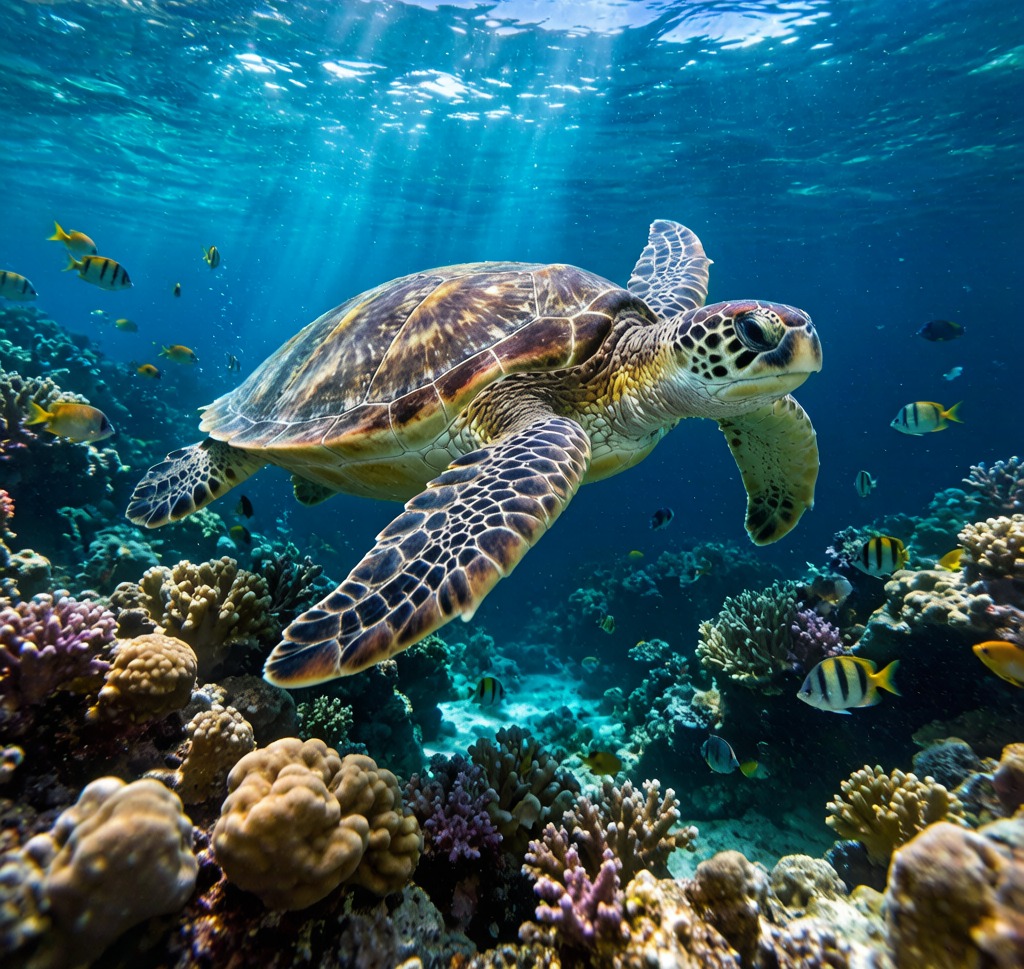
A Green Sea Turtle (Chelonia mydas) gliding over a coral reef in the Caribbean Sea
Overview
The Green Sea Turtle (Chelonia mydas) is one of the largest sea turtles and the most herbivorous of all sea turtle species. Named for the greenish color of its cartilage and body fat rather than its shell, the green sea turtle is a majestic marine reptile that migrates thousands of kilometers between its feeding grounds and nesting beaches throughout its range. These ancient creatures have been swimming the world’s oceans for over 100 million years, yet today they face threats that make them among the most endangered of all sea turtle species.
Adult green sea turtles typically measure 80-150 centimeters in carapace (shell) length and weigh between 65 and 130 kilograms, with the largest individuals reaching 180 kilograms. They have a smooth, heart-shaped carapace that varies from olive green to black, brown, and yellow in color. Unlike most other sea turtles, adult green sea turtles have a predominantly herbivorous diet, feeding primarily on seagrass and algae.
Habitat and Migration
Green sea turtles are found in tropical and subtropical oceans worldwide, from the Atlantic coast of North and South America to the Indo-Pacific region, including the Caribbean, Mediterranean, Red Sea, and throughout the Pacific and Indian Oceans. Their life cycle is intimately tied to both marine and terrestrial environments – adults spend most of their lives in coastal marine habitats such as seagrass meadows and coral reefs, while females return to the same sandy beaches where they hatched to lay their own eggs.
The migration between feeding and nesting grounds is one of the most remarkable journeys in the animal kingdom. Adult females travel from feeding areas to nesting beaches – sometimes over 2,600 kilometers – guided by the Earth’s magnetic field and an innate ability to navigate back to their natal beach. Hatchlings emerge from the sand and orient toward the ocean using visual cues, and immediately begin a frantic swim to offshore waters where they will spend their juvenile years drifting in ocean currents.
Diet and Foraging
Green sea turtles undergo a dietary shift during their lifetime. Hatchlings and juveniles are omnivorous, feeding on insects, crustaceans, jellyfish, and other marine animals. As they mature, their diet transitions almost entirely to plant matter – making green sea turtles the only adult herbivore among the major sea turtle species. Adults feed primarily on seagrass in shallow coastal meadows, as well as various types of algae growing on rocks and reefs.
Seagrass meadows are critically important ecosystems, and green sea turtles play a key role in maintaining their health. By grazing on seagrass, turtles prevent the vegetation from becoming overgrown and dying back, which would release carbon and destabilize the seafloor. This grazing behavior promotes new seagrass growth and increases the productivity and biodiversity of the entire meadow ecosystem. A single large green turtle can consume over 2 kilograms of seagrass per day.
Nesting and Reproduction
Females come ashore to nest every 2-4 years, typically making multiple nests within a single nesting season. During a single season, a female may lay 1 to 8 nests, with approximately 100-200 eggs per nest, every 10-14 days. The process of nesting is physically demanding – the female hauls herself onto the beach above the high tide line, excavates a nest chamber approximately 50 centimeters deep using her rear flippers, deposits her eggs, and carefully covers and conceals the nest before returning to the sea. The entire process takes 1-3 hours per nesting event.
Temperature determines the sex of developing hatchlings – warmer sand temperatures produce mostly females, while cooler sand produces mostly males. With climate change warming beaches, many nesting populations are producing predominantly female hatchlings, which threatens future population viability. The eggs incubate for 50-70 days before hatchlings emerge, typically at night. Only 1 in 1,000 to 1 in 10,000 hatchlings will survive to adulthood.
Conservation Status
The Green Sea Turtle is listed as Endangered on the IUCN Red List, though some populations have shown encouraging signs of recovery thanks to decades of conservation work. Primary threats include: beach development that destroys nesting habitat, accidental capture and drowning in fishing gear (bycatch), hunting of adults and collection of eggs for food, marine pollution including plastic debris that turtles mistake for jellyfish, and climate change affecting sand temperatures and therefore hatchling sex ratios.
Conservation efforts have focused on protecting nesting beaches, reducing bycatch in commercial fisheries, combating illegal hunting and trade, and rehabilitation programs for injured turtles. Many countries have established marine protected areas that encompass important turtle feeding and nesting habitats. Satellite tracking has revolutionized our understanding of sea turtle migration routes, enabling more targeted conservation planning.
Crocodylus porosus, of the Indo-Pacific. Sharing African waterways and coasts with them are the green sea turtle along the shoreline and iconic terrestrial mammals such as the African elephant and the dangerous
a specialized digestive system adapted for processing large quantities of fibrous leaves. The Green Sea Turtle shares the proboscis monkey’s coastal marine environment, illustrating how distantly related
history makes them particularly important for understanding turtle evolution. While the green sea turtle represents typical sea turtle anatomy, the Leatherback shows how evolution can produce radically
populations as it reduces suitable anemone habitat. Other reef-dependent marine species include the green sea turtle and the great white
temperatures drop. Seagrass meadows are vital habitats, providing both food and shelter. The green sea turtle shares these seagrass beds, while the bottlenose dolphin inhabits the same coastal waters. Seasonal
described by Linnaeus in 1766. Phylogenetic studies place the hawksbill as a sister group to the green sea turtle, sharing the unique trait of overlapping shell scutes. The divergence of Atlantic and Indo-Pacific
the Kemp’s ridley and olive ridley turtles, sharing a common ancestor that diverged from the green sea turtle and hawksbill lineage approximately 40 million years ago. Four major regional populations are