 By st20113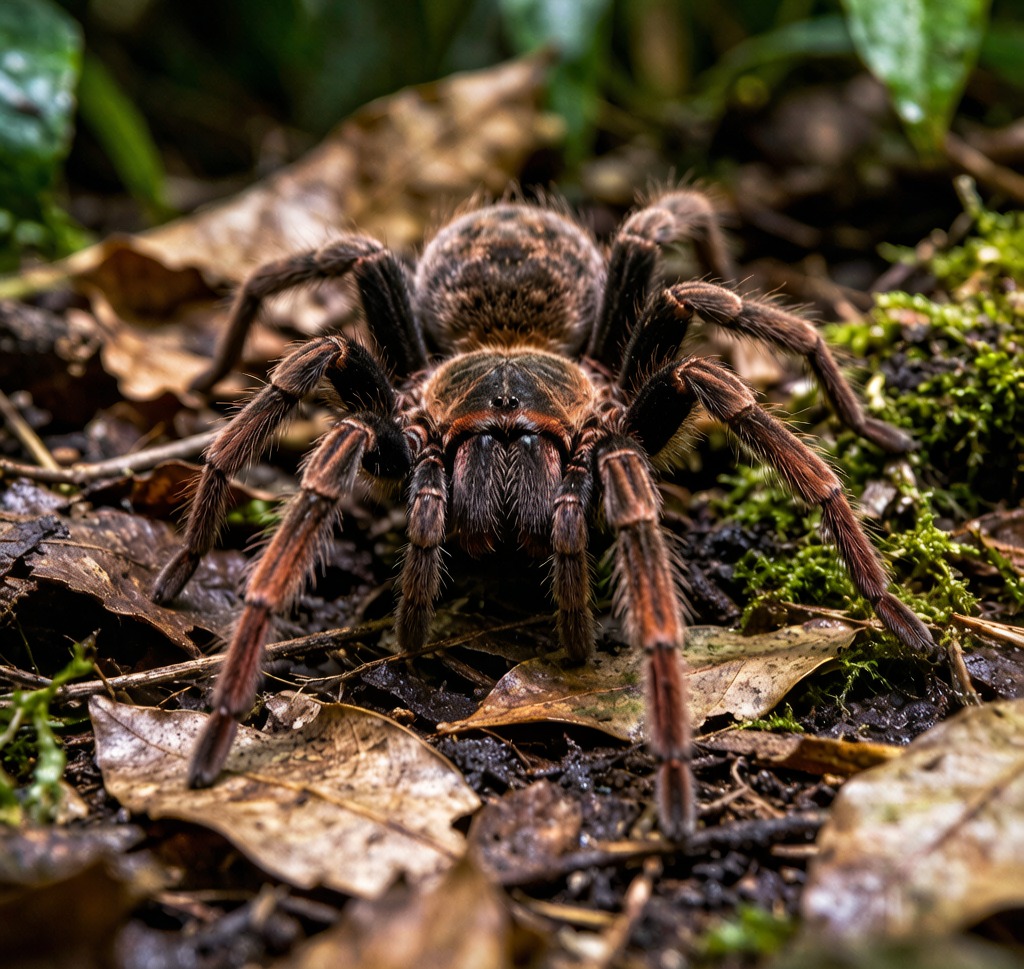
A Goliath Birdeater Tarantula (Theraphosa blondi) on the rainforest floor in the Amazon basin
Overview
Tarantulas comprise the family Theraphosidae, which contains over 1,000 species of large, often hairy spiders found in the tropical, subtropical, and warm temperate regions of the world. Despite their fearsome reputation – fueled by Hollywood depictions of giant, man-eating “tarantulas” – most species are docile, secretive creatures that play important roles as predators in their native ecosystems. Tarantulas are among the longest-lived spiders, with some females living 20-30 years or more.
Tarantulas vary considerably in size depending on the species. The smallest species have leg spans of around 25 millimeters, while the largest – the Goliath Birdeater (Theraphosa blondi) of South America – can reach a leg span of up to 30 centimeters and weigh over 170 grams, making it one of the largest spiders in the world by mass. Their bodies are covered in dense, fine hairs called setae, many of which are urticating – meaning they can be flicked at predators as a defensive mechanism, causing irritation to eyes and skin.
Distribution and Habitat
Tarantulas are found on every continent except Antarctica, with the greatest diversity in the tropical regions of Central and South America, Africa, and Asia. New World tarantulas (those in the Americas) are predominantly terrestrial or burrowing and are generally docile, while Old World species (Africa, Asia, Australia) are more often arboreal and tend to be more defensive and possess more potent venom.
Different species have evolved diverse habitat preferences. Many tropical species are burrowers, excavating deep tunnels in the forest floor where they spend most of their time, emerging only at night to hunt. Other species are arboreal, living in silk-lined retreats in trees or on cliffs. Some species, particularly in desert regions, use crevices in rocks or abandoned burrows of other animals. The availability of suitable retreats and prey availability are the primary factors determining habitat suitability.
Hunting and Diet
Tarantulas are ambush predators that rely on stealth rather than speed. They wait motionless near their burrow entrance or in a tree hollow, detecting prey through vibrations in their legs and webs. When a suitable prey animal comes within striking range – typically insects, though some of the larger species tackle small vertebrates including rodents, frogs, lizards, and occasionally birds – the tarantula lunges rapidly, grasping the prey with its pedipalps and fangs.
The tarantula’s venom is injected through hollow fangs, paralyzing the prey within seconds. The venom contains a cocktail of neurotoxins and digestive enzymes – the latter beginning to break down the prey’s tissues before the tarantula even begins feeding. The tarantula then liquefies the prey’s internal organs with digestive fluids and sucks the resulting nutrient soup through its small mouth opening. A single large meal can sustain a tarantula for several weeks to several months, depending on the size of the prey.
Defense Mechanisms
Tarantulas have evolved several effective defense mechanisms beyond their venom. Their first line of defense is camouflage and remaining hidden – most species spend the vast majority of their lives in burrows or retreats, and their brown, black, or mottled coloring provides excellent concealment. When threatened, many species rear up into a defensive posture, exposing their large fangs.
Perhaps the most distinctive defensive behavior is the use of urticating hairs. New World tarantulas possess specialized hairs on their abdomen called urticating setae that can be kicked off with rapid movements of their back legs. These microscopic, barbed hairs become airborne and embed in the skin and mucous membranes of predators, causing intense itching, irritation, and potentially respiratory distress. Some species have developed these hairs over millions of years to the point where they are more effective than their venom in deterring predators like coatis and monkeys.
Reproduction and Life Cycle
Tarantula reproduction is a dramatic and often dangerous affair, particularly for males. When a male is ready to mate, he seeks out a female’s burrow by following the silk dragline she leaves behind. Approaching a female’s burrow is risky for males – if the female is not receptive, she may attack and kill him. Males of many species perform an elaborate courtship display, tapping and vibrating the ground near the female’s burrow to signal their peaceful intentions before attempting to mate.
After mating, the female produces an egg sac containing 200 to 1,000 eggs, depending on the species, which she carries in her burrow and guards aggressively. The spiderlings hatch after several months and disperse to establish their own burrows. Tarantulas are renowned for their extreme longevity – females of some species have been documented living 30-40 years in captivity, and a documented female was known to have lived for 40 years at the Berlin Zoological Garden.