 By st20113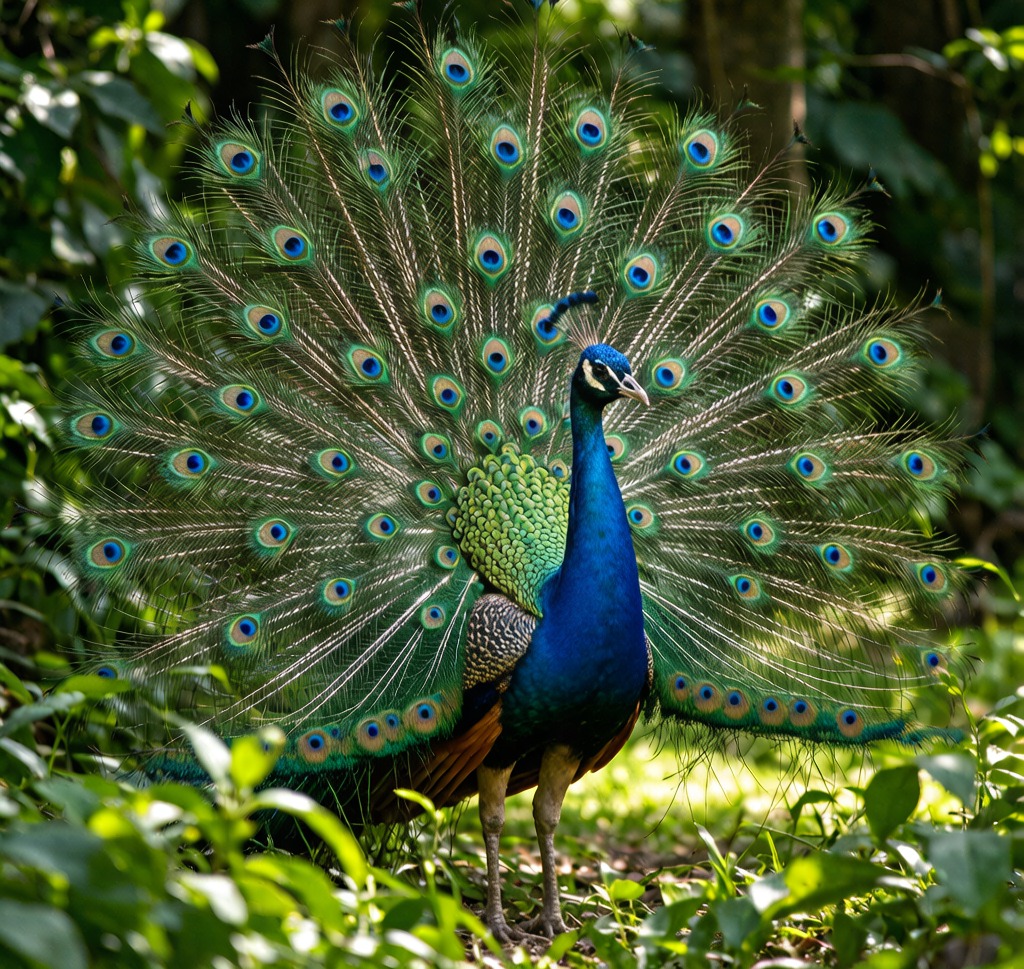
A male Indian Peafowl (Pavo cristatus) displaying its magnificent train feathers in a forest clearing
Overview
The Indian Peafowl (Pavo cristatus), known popularly as the Peacock, is a large, spectacularly plumaged bird native to the Indian subcontinent. The male, known as the peacock, is renowned worldwide for its extraordinarily elaborate courtship display – a fanned tail of iridescent feathers that is considered one of the most beautiful sights in the natural world. The Indian Peafowl holds the distinction of being the national bird of India.
Male peafowl measure approximately 100-115 centimeters in body length, with an additional train of up to 150 centimeters. The body is a deep iridescent blue-green, with a dark, almost black head adorned with a crest of bronze-green feathers. The famous train is not the tail feathers themselves – rather, it is the greatly elongated upper tail coverts that can be raised and fanned into a magnificent semicircle during courtship displays. Each train feather is tipped with an iridescent eye-spot (ocellus) in blue, gold, and bronze.
The female, known as a peahen, is far more understated in appearance, with a dull brownish-green plumage that provides excellent camouflage while nesting on the ground.
Habitat and Distribution
The Indian Peafowl is native to the Indian subcontinent, where it occurs across most of the Indian subcontinent, Sri Lanka, and parts of Pakistan, Bangladesh, and Nepal. Its preferred habitat is open deciduous forest and dense scrubland, typically below elevations of 2,000 meters. Peafowl are most commonly found in areas with a mosaic of forest cover and open ground, as they forage primarily on the ground but roost and nest in trees.
While native to South Asia, the Indian Peafowl has been introduced to many parts of the world as an ornamental bird in parks and estates. Feral populations have established in parts of Australia, New Zealand, the United States (particularly California and Florida), and various Caribbean islands. These introduced populations thrive in similar habitats but can sometimes become agricultural pests or negatively impact local ecosystems through competition with native species.
Diet and Behavior
Indian Peafowl are omnivorous ground feeders. Their diet consists primarily of grains, seeds, berries, and fruits, supplemented with insects, small reptiles, and even small mammals. On agricultural land, peafowl will readily feed on crops such as tomatoes, cucumbers, and tender shoots, which brings them into conflict with farmers. They forage by scratching and pecking at the ground with their strong feet.
Peafowl are diurnal, spending the day foraging in small groups and roosting in trees at night. Their call is a distinctive, loud, and mournful scream that is often likened to a human cry or call for help. This haunting call, usually heard at dawn and dusk, is one of the characteristic sounds of the Indian countryside. Males are largely solitary outside the breeding season, while females move in small groups with their young.
Breeding and the Display
The breeding season varies by region but typically occurs during the monsoon period, from June to August in India. A male will establish a territory and begin his elaborate courtship display, which involves raising his train, spreading it into a magnificent fan, and strutting in front of females while vibrating the feathers to produce a low, rhythmic sound. The ocelli (eye-spots) catch and reflect light, creating a shimmering effect that has captivated observers for millennia.
After mating, the female lays a clutch of 4-8 eggs in a shallow nest scraped in the ground and lined with leaves and debris. She incubates the eggs alone for 27-30 days, after which the precocial chicks hatch and are able to walk and feed within hours. The mother leads her brood to feeding areas, where they eat grains, insects, and small invertebrates. Peafowl chicks have a high mortality rate, with predation from snakes, mongoose, and large birds being the primary cause of losses.
Cultural Significance
The Indian Peafowl has been celebrated in human culture for thousands of years. In Hindu mythology, the god Kartikeya rides a peacock as his vehicle. The bird has been depicted in ancient Egyptian art, and peacocks were imported to the courts of Babylon, Persia, Greece, and Rome as symbols of wealth and prestige. Alexander the Great was reportedly fascinated by the bird and attempted to bring them back to Greece.
In the wild, the peacock serves as a beautiful ambassador for the ecosystems of South Asia, helping to draw public attention to the conservation of forest habitats. While the species remains common in its native range and is listed as Least Concern on the IUCN Red List, habitat loss and hunting in some areas are causing local population declines. The peacock’s iconic beauty continues to inspire art, literature, and religious symbolism around the world.