 By st20113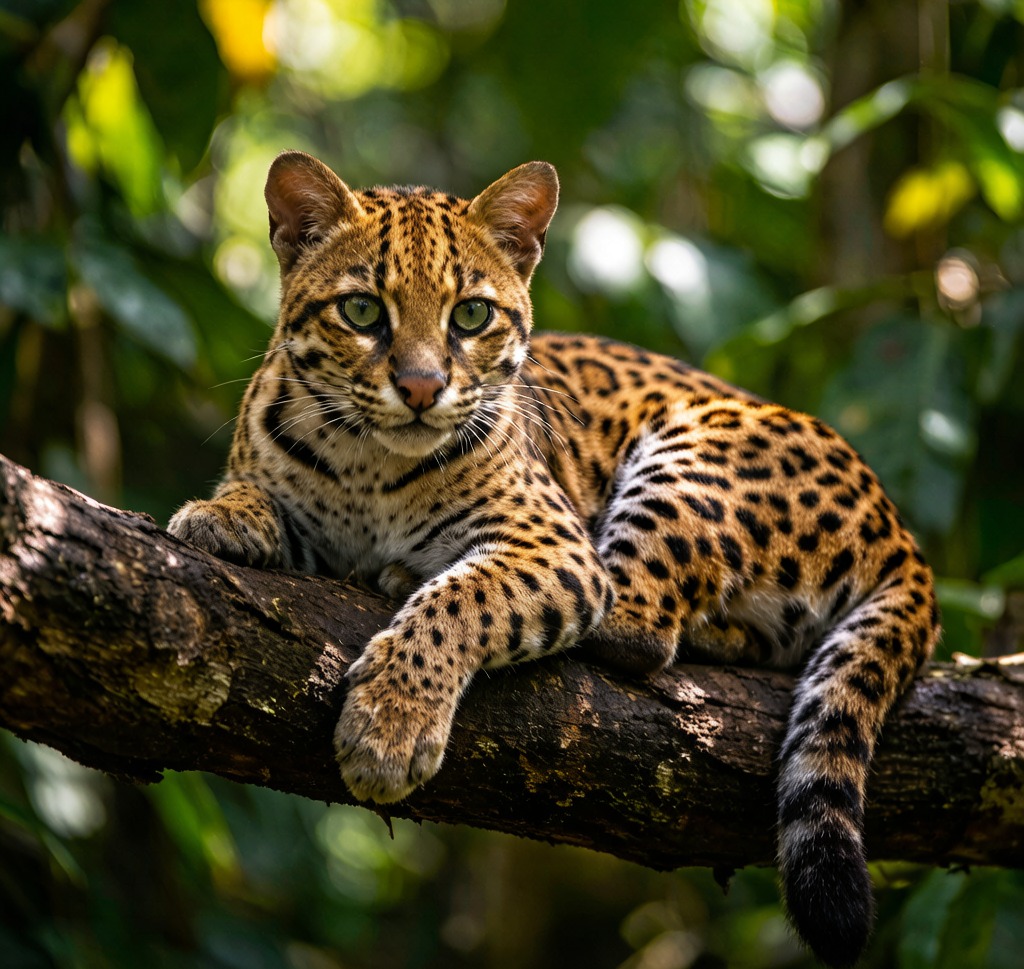
An Ocelot (Leopardus pardalis) resting on a branch in the Amazon rainforest
Overview
The Ocelot (Leopardus pardalis) is a medium-sized wild cat native to Central and South America. With its beautiful spotted coat and striking green eyes, the ocelot has captured human fascination for centuries. Despite its wild nature, the ocelot is an elusive and primarily nocturnal hunter, making it one of the more difficult wild cats to observe in the wild.
Ocelots are approximately twice the size of a domestic cat, weighing between 8 and 18 kilograms. They have a stocky, muscular build with relatively short legs and a long, thick tail that provides balance during arboreal movement. Their coat displays an intricate pattern of irregular rosettes, stripes, and spots in shades of golden yellow, tan, and cream on a darker background – a pattern that provides exceptional camouflage in dappled forest light.
Habitat and Distribution
Ocelots occupy a vast range throughout Central and South America, from the southern United States (primarily Texas) through Central America and into northern Argentina. Their habitat preferences are remarkably varied – they are found in tropical rainforests, scrub forests, coastal mangroves, and even dry thorny scrubland. The key requirements for ocelot habitat are sufficient ground cover for hunting and resting, and access to water sources.
They are highly adaptable and can survive in human-modified landscapes, though they prefer dense vegetation. Unlike many other wild cats, ocelots are comfortable in trees and spend a significant portion of their time in the forest canopy, where they hunt and rest on horizontal branches. Each ocelot maintains a home range of 2 to 18 square kilometers, with males typically maintaining larger territories that overlap with those of several females.
Diet and Hunting Behavior
Ocelots are opportunistic carnivores with a diverse diet. They prey primarily on small to medium-sized mammals including rodents, opossums, rabbits, and agoutis, but also hunt birds, reptiles, amphibians, and large invertebrates. Fish are also occasionally taken when ocelots hunt along waterways. Their hunting strategy combines stealth and patience – they stalk prey slowly through dense undergrowth, then deliver a rapid pounce.
Unlike larger big cats that can tackle large prey, ocelots typically kill animals weighing less than 1 kilogram. They kill with a bite to the back of the neck or skull, and small prey is consumed quickly, while larger catches may be cached in trees or dense vegetation for later consumption. Their excellent night vision makes them highly effective nocturnal predators.
Reproduction
Ocelots do not have a fixed breeding season and can reproduce year-round in tropical regions, though births may be more concentrated in certain periods depending on the region. After a gestation period of approximately 79-85 days, the female gives birth to a litter of 1 to 3 kittens in a concealed den, which may be located in a hollow tree, dense thorny vegetation, or a rocky crevice.
The kittens are born with their eyes closed and are entirely dependent on their mother’s milk. Their eyes open at around 15 days of age, and they begin to eat solid food at around 6-8 weeks. The mother teaches them to hunt over the next several months, and young ocelots become independent at approximately 1 year of age. Ocelots reach sexual maturity at around 18-22 months. In the wild, their lifespan is estimated at 7-10 years, though individuals in captivity have lived over 20 years.
Conservation
Once heavily hunted for its beautiful fur, the ocelot population declined dramatically in the 20th century. Although the international fur trade has been largely suppressed since the 1980s, ocelots continue to face significant threats from habitat loss due to deforestation for agriculture, ranching, and infrastructure development. Road mortality and conflict with farmers who view ocelots as livestock threats also take their toll.
Despite these pressures, the ocelot remains the most abundant small wild cat in the Americas. It is listed as Least Concern on the IUCN Red List, partly because of its large range and adaptability. Conservation efforts focus on protecting connected corridors of forest habitat, reducing human-wildlife conflict, and combating illegal wildlife trade.