 By st20113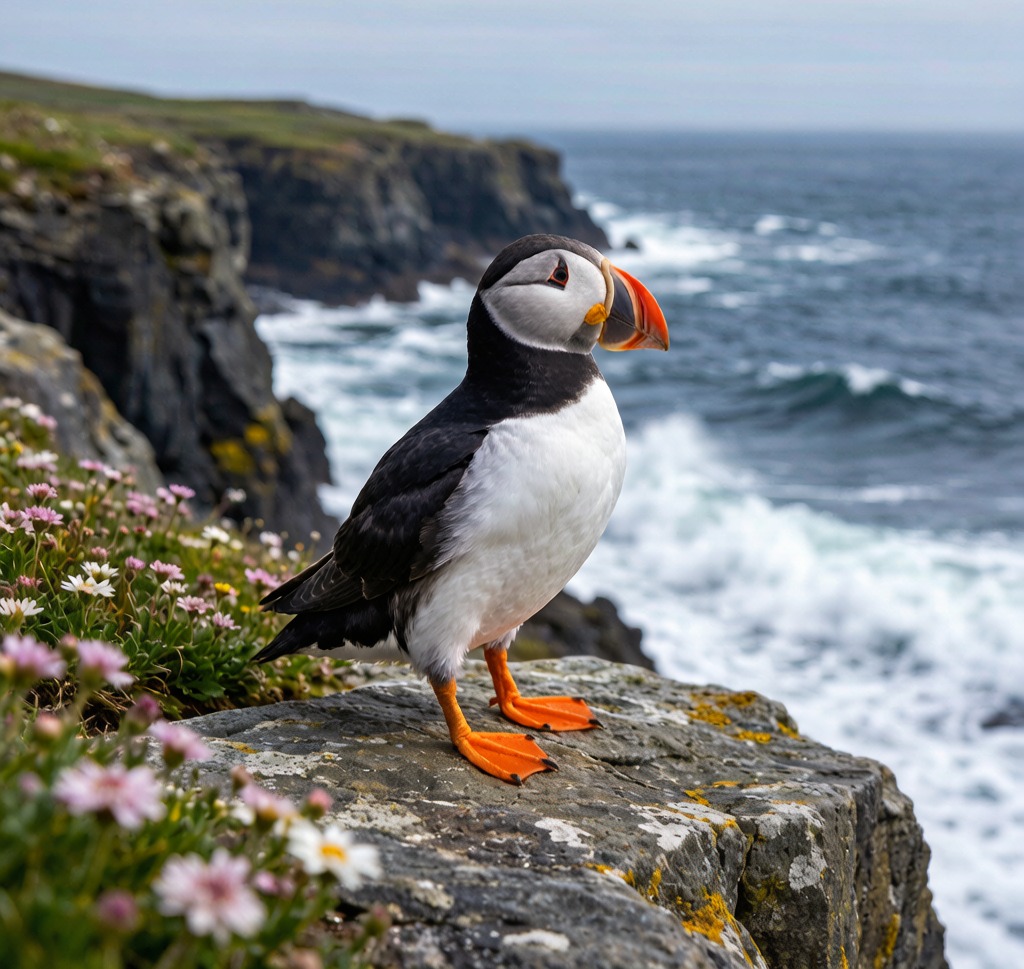
An Atlantic Puffin (Fratercula arctica) standing on a coastal cliff in Iceland
Overview
The Atlantic Puffin (Fratercula arctica) is a small seabird belonging to the auk family (Alcidae). Known for its distinctive colorful beak and penguin-like coloration, the puffin is one of the most beloved and recognizable seabirds in the North Atlantic Ocean. Despite its clown-like appearance, the Atlantic Puffin is an expert flyer and an accomplished swimmer, capable of diving to depths of over 60 meters in pursuit of small fish.
Adult puffins measure approximately 28-30 centimeters in length with a wingspan of about 50 centimeters. Their most striking feature is their large, triangular bill, which displays vibrant orange, yellow, and blue markings during the breeding season. The rest of the body is covered in sleek black plumage on the back and wings, with a clean white underside. Their feet are bright orange, and their face is marked with a distinctive black eye stripe and grayish-white cheeks.
Habitat and Distribution
Atlantic Puffins breed in large colonies along the rocky coastlines of the North Atlantic, from the northeastern coast of North America (including Newfoundland and Labrador) across to Greenland, Iceland, Scandinavia, and the western coasts of the British Isles. The largest breeding colonies can be found on offshore islands where there is minimal terrestrial predation. During the winter months, puffins spend most of their time far out at sea, often hundreds of kilometers from land.
Their breeding habitat consists of coastal cliffs, offshore islands, and rocky shorelines with grassy slopes where they can excavate burrows for nesting. These burrows are typically dug into soft soil or among rock crevices and are shared with other seabirds such as razorbills and guillemots. A single white egg is laid each year in these underground burrows, which provides protection from predators and harsh weather.
Diet and Feeding Behavior
Atlantic Puffins are pursuit divers, using their wings to “fly” underwater while chasing small prey. Their diet consists primarily of small schooling fish such as sand eels, herring, and capelin, along with zooplankton and various marine invertebrates. An adult puffin can carry up to a dozen small fish crosswise in its bill at one time, holding them in place with a unique hinge mechanism in the beak and a rough tongue.
Provisioning of chicks is a demanding task. Parent puffins make multiple foraging trips per day, each time returning with a bill-full of fish for their single chick (called a puffling). Research has shown that healthy puffin colonies can deliver thousands of fish to their nestlings over the course of a breeding season, making them important indicators of the health of the marine ecosystem.
Breeding and Life Cycle
Puffins are faithful to their nest site and often to the same partner year after year. They engage in elaborate billing displays where they touch beaks and appear to “kiss,” strengthening their pair bond. The breeding season begins in late March to May, depending on latitude. After copulation, a single egg is laid in the burrow and incubated by both parents for approximately 36-45 days.
The chick hatches covered in dark down and is fed exclusively on fish by both parents for the next 34-60 days. Once fledged, the young puffling leaves the burrow at night, making its way to the sea, where it will spend the next 2-3 years at sea before returning to land to breed for the first time at around 4-5 years of age. Atlantic Puffins can live for over 20 years, with the oldest recorded individual reaching 36 years of age.
Predators and Threats
In their breeding colonies, Atlantic Puffins face predation from a variety of aerial and terrestrial predators. Large gulls, particularly the Great Black-backed Gull and Herring Gull, are known to catch and eat adult puffins and their chicks. On the ground, rats, ferrets, and foxes can decimate puffin colonies by raiding burrows for eggs and chicks. In some regions, domestic cats also pose a significant threat to puffin colonies.
At sea, puffins are preyed upon by marine mammals including seals and large fish such as Atlantic Cod and Pollock. The greatest modern threat to Atlantic Puffins, however, comes from human activity. Climate change has disrupted ocean temperatures and prey fish populations, while commercial fishing operations compete directly with puffins for the same forage fish stocks. Pollution, oil spills, and bycatch in fishing nets also contribute to puffin mortality.
Conservation Status
The Atlantic Puffin is currently listed as Vulnerable on the IUCN Red List. Populations have declined significantly in parts of their range, particularly in the southern parts of their breeding distribution. In the Gulf of Maine and around southern England, puffin populations have dropped by up to 50% in recent decades due to warming sea temperatures and declining fish stocks. Conservation measures include protecting breeding islands from introduced predators, regulating fishing in puffin foraging areas, and monitoring colony health through annual census programs like the International Puffin Census.
[…] stretches of sea on the planet. Often called the “royal albatross,” this magnificent seabird has inspired countless legends, most famously in Samuel Taylor Coleridge’s poem “The […]