 By st20113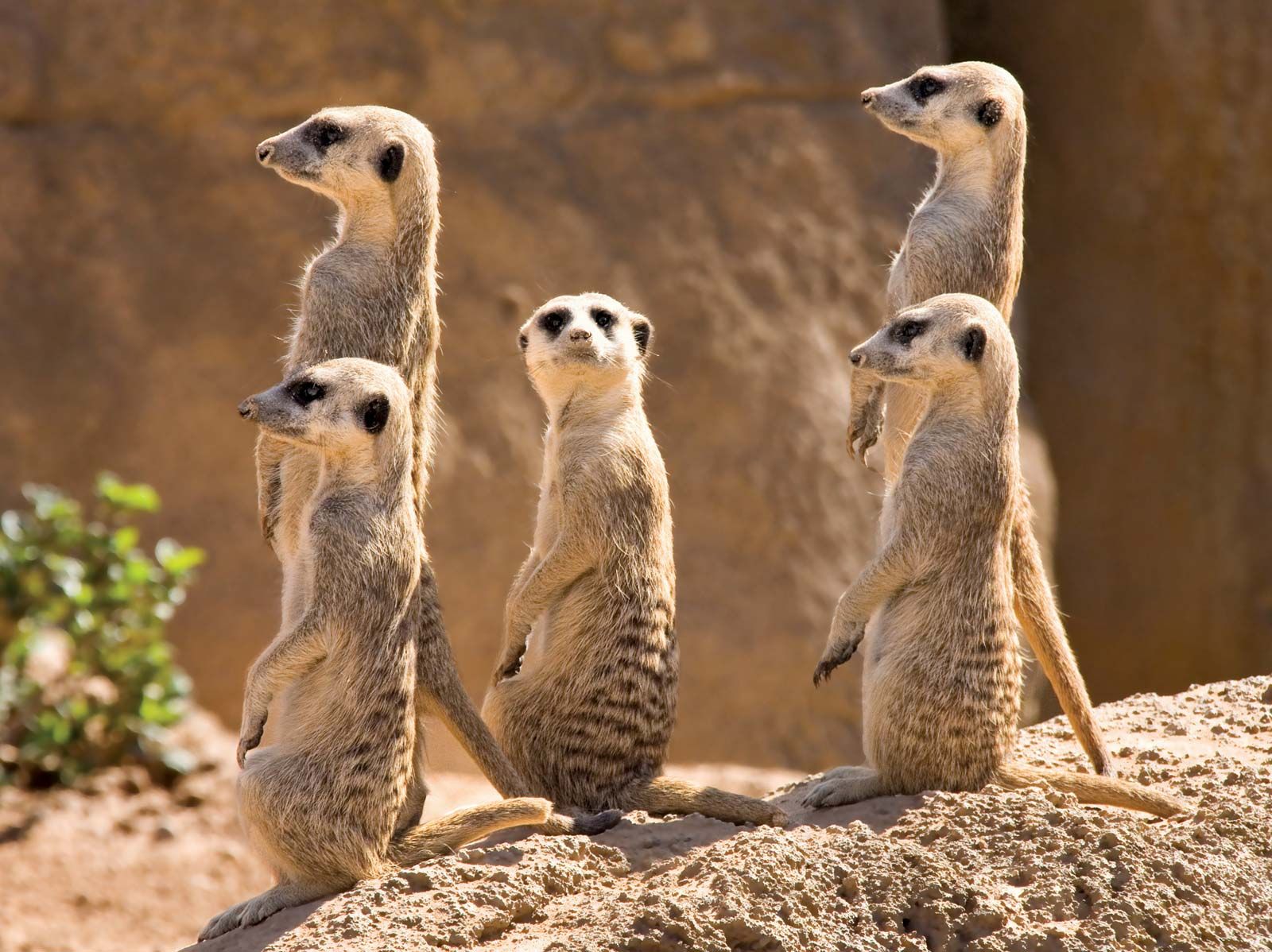
Introduction
The meerkat (Suricata suricatta), also known as the slender-tailed meerkat, is a small carnivorous mammal belonging to the mongoose family Herpestidae. Despite its name, the meerkat is not a cat but rather a mongoose. Meerkats are renowned for their upright sentinel posture, highly social behavior, and complex cooperative living arrangements that have made them one of Africa’s most recognizable small mammals.
Taxonomy and Classification
The meerkat was first formally described by Johann Friedrich Gmelin in 1788. It is the only member of the genus Suricata, placing it within the order Carnivora. Within the Herpestidae family, which includes 18 genera and approximately 34 species of mongooses, the meerkat occupies a unique ecological niche. Genetic studies have confirmed its position within this family.
Physical Characteristics
Meerkats are slender animals, measuring about 25 to 35 cm (10 to 14 inches) in body length, with an additional 19 to 24 cm (7.5 to 9.5 inches) for the tail. They typically weigh between 0.6 and 1.0 kg (1.3 to 2.2 lbs). Their fur is typically yellowish-brown to light gray, with dark stripes across the back. The face is pointed with dark patches around the eyes, which helps reduce glare from the sun. Their eyes have horizontal pupils that provide a wide field of vision, essential for spotting predators.
Distribution and Habitat
Meerkats are native to the southwestern parts of the African continent, particularly the Kalahari Desert region spanning Botswana, Namibia, and South Africa. They inhabit arid, open landscapes such as savannas, dry scrublands, and the edges of the Namib and Sahara deserts. They require areas with suitable soil for burrowing.
Social Structure and Behavior
Meerkats live in highly organized social groups called mobs or gangs, typically comprising 10 to 30 individuals. These groups are cooperative societies where members share responsibilities including foraging, babysitting, and standing guard. One dominant pair within the group produces offspring, while subordinate members assist in raising the young. One of the most distinctive behaviors is their sentinel duty, where one individual stands upright on its hind legs while others forage, watching for predators.
Diet and Foraging
As insectivores, meerkats primarily feed on insects including beetles, larvae, caterpillars, and termites. They also consume small vertebrates such as lizards, scorpions, and small snakes. Meerkats are immune to certain venoms, including the strong venom of scorpions found in the Kalahari.
Reproduction
Meerkats breed up to three times per year after a gestation period of approximately 11 weeks. Litters typically consist of 2 to 5 pups, which are born blind and hairless in underground burrows. The entire group participates in caring for the young, with subordinate members regurgitating food for pups. Pups begin foraging with the group at about one month of age.
Conservation Status
The meerkat is currently listed as a species of Least Concern by the IUCN, with population numbers considered stable across its range. Their adaptability to semi-arid environments and ability to thrive in human-modified landscapes have contributed to their stable conservation status. However, habitat degradation and drought events linked to climate change pose potential future threats to local populations.